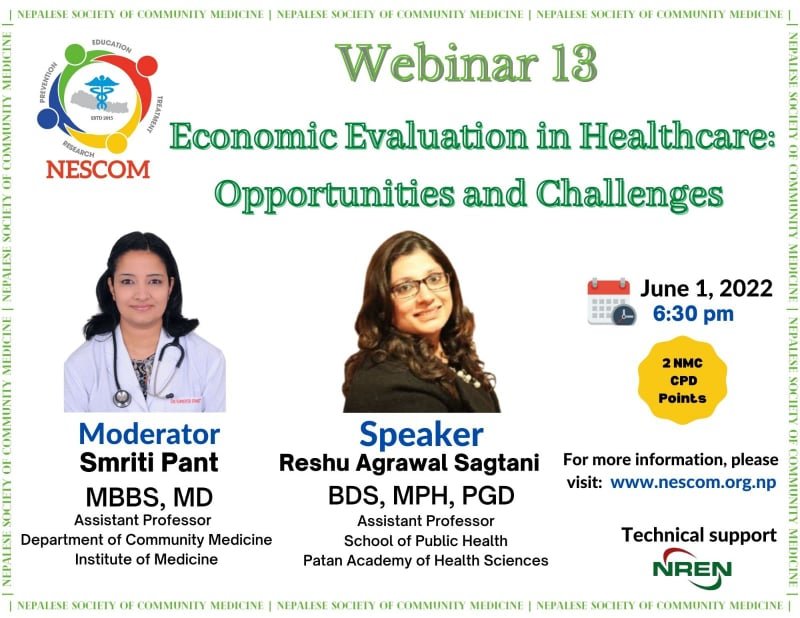
Economic Evaluation in Health Care: Opportunities and Challenges,1st June,2022

Summary:

Economic evaluation is the comparative analysis of alternative course of action in terms of both their cost and their consequences. In health sector, where a lot of budget is needed, economic evaluation becomes an important aspect to look upon; the alternatives of any investment, interventions, decisions etc. should be carefully analyzed and proper choice to be made, so the consequences and benefits is accountable and worth the cost. According to the demand of the economic investment in health sector; the type, steps and reporting of the evaluation should be carefully monitored for better and expected outcome. In the context of Nepal, we lack independent body in government level for proper economic evaluation in health sector which should be a concern. Hence, dedicated and trained human resources in decision making for quality and optimized investment in health services are a must.

Brief Background:

The Master of ceremony, Dr. Baidehi Upadhyay initiated the webinar with the introduction of the speaker Dr. Reshu Agrawal Sagtani and the moderator Dr. Smirti Pant.

Dr. Agrawal Sagtani is the Assistant Professor in School of Public Health at Patan Academy of Health Sciences (PAHS), Kathmandu, Nepal. She received her Post Graduate Diploma in Health Economics, Health Care Financing and Policy from Public Health Foundation of India. She also has a Diploma in Biostatistics and Research Methodology from Global Institute of Medical Sciences, India. She completed her BDS from College of Dental Surgery, and Masters in Public Health (MPH) from School of Public Health & Community Medicine, B.P Koirala Institute of Health Sciences (BPKIHS), Dharan, Nepal. She is also resource faculty of Biostatistics for MBBS students and Epidemiology of NCDs for MPH students and health economics for Master’s program at PAHS and Kathmandu University School of Medical Sciences (KUSMS), Dhulikhel, Nepal. She also contributes as Editorial board member of PLoS One journal and Journal of Patan Academy of Health Sciences (JPAHS). With her outstanding performance with researches, she is a recipient of national and international research grants and also National Level Consultant for projects related to costing of health care interventions. Her research interests include economic evaluation and policy research with primary focus on prevention and control of Non- Communicable Diseases (NCDs).

Dr. Pant is Assistant Professor in Department of Community Medicine, Maharajgunj Medical Campus and Institute of Medicine, Kathmandu, Nepal. She did her MBBS and MD in Community Medicine from Kathmandu Medical College, Kathmandu, Nepal. She is a life member of Nepalese Society of Community Medicine (NESCOM). She is a recipient of Best Paper (Poster) at 4th National Summit of Health and Population Scientists of Nepal and also recipient of University Grant Commission, research grant for Master’s Thesis. Her research interest and publications include papers on COVID-19, Nutrition, Air pollution, G6PD etc.

Dr. Pant started the session with the introduction of economic evaluation, understanding and use of economic evidence in decision making; by individuals, companies and in government levels. She focused on the importance of understanding of economic evidence in public health interventions which is an integral part of evidence based public health. Then, the speaker of the session, Dr. Agrawal gave a clear view of the concept of economic evaluation and its importance in health sector. She discussed the fundamental job of any economic evaluation and rationale of using it in public health. The types, steps of economic evaluation and the importance of reporting were discussed with an example of a systematic review done on economic evaluation guidelines in low- and middle-income countries. Then she further reiterated about the scenario of economic evaluation in health sector in Nepal, talking about the existing Monitoring and Evaluation guideline and also some evidences of studies done on economics of health sector. She then talked about the debates surrounding economic evaluation, the opportunities and challenges in present scenario of our country.

The presentation was wrapped up with few questions raised by the participants whom the speaker answered with very much clarity and precision. Five zoom poll questions were put forward in regard to the presentation and understanding about the society NESCOM. The webinar lasted for about 1 and half hours with about 100 participants and ended with the announcement of an upcoming webinar on “Grant Writing in Academia”.

Objective of the Webinar:

1.To know the concept of economic evaluation

2.To know the rationale of using it in public health

3.To know the types, steps and reporting of economic evaluation

4.To know the guidelines, evidence, debate, opportunities and challenges around economic evaluation in Nepal

Key points that came out during the discussion:

  1. Health budget of Government of Nepal 2079/80 has decided to increase the list of free essential drugs from 70 to 98, increase the capital and infrastructure development, focus more on digital technology, screening at least once for NCDs in people over 40 years and others. But the pertinent question is whether the investments are up to the mark? The economic evaluation thus focuses in the betterment of these investments and the expected outcome
  2. Economic evaluation is related to costs and consequences. Based on cost and consequences we need to make the decision regarding a choice. Thus, economic evaluation is the comparative analysis of alternative courses of action in terms of both their costs and their consequences
  3. The fundamental jobs of any economic evaluation are to recognize, measure, value and compare the costs and consequences of the alternatives being considered. It makes explicit the total resources consumed and the benefits generated by a specific intervention or program
  4. The rationale for doing economic evaluation is: Health is our Constitutional right; the state should take care of all our health. But practically it is not possible to cater to all our health care needs and demands because of scarce resources – human, time, facilities, equipment, knowledge, etc. Also, there is competing claims, and alternative choices for the investment to be done. Systematic analysis for relevant alternatives is thus important measurement to ensure efficiency
  5. Types of Economic Evaluation:

          Cost minimization analysis- Choose to reduce the amount of cost

  • Cost effectiveness analysis – Choose to improve the morbidity and mortality outcome.
  • Cost utility analysis- Cost to avoid 1 DALY or gaining 1 QALY, choose the one with less cost.
  • Cost consequence analysis – Consequences scenarios is made before and investment done accordingly.
  • Costs benefit analysis – Used to transfer budgets from one sector to other in government levels.
  • Social/Return of Investment – Benefits also in terms of social changes, cultural adaptation along with monetary benefit.
  1. Steps in conducting an economic evaluation
  • Framing the problem: The study question, perspective, time frame and analytic horizon.
  • Choosing the baseline comparator and alternative intervention: Comparator, target population.
  • Identifying the outcome measures: Intermediate/final outcomes, source of effectiveness data.
  • Identify the intervention and outcome costs: Direct/indirect costs, discounting.
  • Construct the decision model: Decision tree or decision analytical modeling.
  • Analyze and interpret the results.
  • Perform sensitivity analyses: Addressing uncertainty.
  • Presentation of results: Reporting guidelines.
  1. Some studies were reviewed to see if economic evaluation guidelines are being used which showed some countries use mandatory guidelines; whether systemic analysis is done or not, decision analysis, analytic horizon kept into consideration or not
  2. There is no mandatory guideline for economic evaluation in Nepal, though Monitoring and Evaluation Guideline exists. This guideline is an important aspect of our health care system which clearly states that we need to analyze efficiency and cost effectiveness and compare it to make sure the input comes with effective outcome. The pharmacoeconomics in Nepal also discusses and designs the free drugs lists in Nepal. Many but not enough studies are being done for the importance of economic evaluation in public health sector in Nepal
  3. Health care should not only focus in efficient use of resources, it has to be thought from equity perspective as well, which may not be practically true. So, assessment of distributional inequalities is important, there may be a tradeoff between equity and efficiency
  4. Economic evaluation may be complex in certain scenario like in social determinants of health where determinants cannot be easily quantified and also in genetics where it cannot be measured.

Points for the policy brief:

Since there are no mandatory guidelines for economic evaluation in health care system in Nepal, the government should focus more in these aspects. There is a need of independent body in the Governmental sector for Health Technology Assessment and Economic Evaluation for effectiveness. The changing political scenario gives hope that accountability holds in the health care system, the federalization of health system with autonomy to local levels can be a opportunity which needs to be grabbed.

Points to be discussed in the executive committee:

1.Role of Nepalese Society of Community Medicine (NESCOM) to discuss the possibility for more extensive courses and workshop related to economic evaluation in health care in Nepal

2.To perform more research and study to explore the cost benefit analysis of preventive medicine over the curative medicine; the expense over the curative medicine could definitely be reduced focusing and advocating the use of preventive medicine

Conclusion:

Economic evaluation in health care is important as it is necessary to make proper decisions of investments for better effectiveness and benefits of the outcome. There are many challenges to make the health system better in our context, however, opportunities that are arising should be utilized and proper economic evaluation prior to any health-related decisions should be done with an effective mandatory guideline.
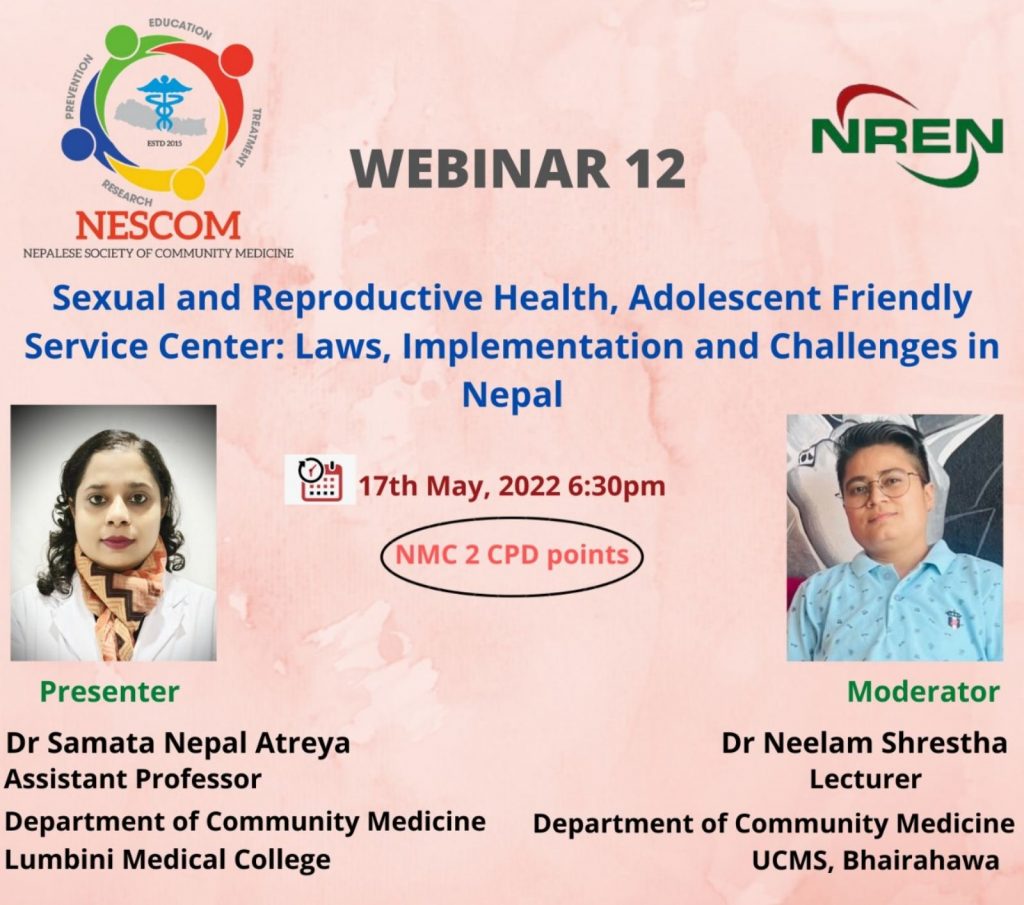
12th Webinar Summary Report on “Sexual and Reproductive Health, Adolescent Friendly Service Centre: Laws, Implementation and Challenges in Nepal, 17th May, 2022

Summary:

Sexual and reproductive health is an essential component of health and one of the pillars of Sustainable Development Goals (SDGs). Nepal is predominantly a country with young population with large proportion of population below age 30. The proportion of adolescents in Nepal is higher than the proportion globally. Despite Nepal being the first country in Southeast Asia that focused on adolescent health and development, still there are many hurdles that affect adolescent sexual and reproductive health. Among them, child marriage, menstrual hygiene management, menstrual taboo, gender-based violence, cyber bullying and exploitation remain the most important areas that urgent need attention and major improvements.

Brief Background:

The master of ceremony – Dr. Sujil Manandhar started the proceedings of the webinar by introducing the speaker, Dr. Samata Nepal Atreya and the moderator, Dr. Neelam Shrestha.

Dr. Atreya works as an Assistant Professor at Department of Community Medicine, Lumbini Medical College, Kathmandu University. She is also a member secretary of Institutional Review Committee of LMC and also a research supervisor for medical students. She is a peer reviewer in different journals and her areas of interests are adolescent health, women health and NCDs.

Dr. Shrestha who was the moderator of the program, currently works as a Lecturer at Department of Community Medicine, Universal College of Medical Sciences, Bhairahawa. She is also a research supervisor for students of Bachelor in Public health.

Dr. Atreya started the presentation with justification of the topic: Sexual and Reproductive Health, Adolescent Friendly Service Center: Laws, Implementation and Challenges in Nepal, which she began with a brief definition of the adolescence phase and the changes that occur during this phase. She then explained about the different milestones that Nepal has achieved in terms of adolescent sexual and reproductive health with the latest revised strategy plan implemented on 2075 BS. She then described about the burden of different problems like child marriage, violence, menstrual taboos, cyber bullying in Nepal. The webinar also highlighted about the possible challenges at different levels we have to face in-order to improve the adolescent sexual and reproductive health in Nepal. Finally, Dr. Atreya talked about the areas that can be improved and policies that can be made to bring a positive change in the scenario of adolescent health in Nepal.

The completion of the presentation was followed by ice-breaking Zoom poll session focusing on understanding of the topic and about the Nepalese Society of Community Medicine (NESCOM).

Some interesting questions were raised after the poll questions which the speaker answered with excellent clarity and precision. The webinar lasted for 1.25 hour with over 90 participants.

The webinar ended with the concluding remarks by Dr. Sujil Manandhar (MC for the program) along with the announcement of the upcoming NESCOM webinar on “Economic evaluation in healthcare: Opportunities and challenges” on 1st June, 2022.

Objectives of the Webinar:

  1. To understand the global and regional burden of adolescent sexual and reproductive health related problems.
  1. To understand the current scenario of adolescent sexual and reproductive health in Nepal.
  2. To update on the strategies being conducted to improve adolescent health.
  3. To update on different policies needed to improve adolescent health.

Key Points Discussed:

  1. According to WHO, adolescence is defined as age between 10-19 years which is further subdivided into early adolescence (10-13 years), middle adolescence (14-17 years), and late adolescence (18-19 years).
  2. Adolescence phase is very vulnerable as it is a transition phase between childhood and adulthood where there are physical and cognitive changes, progression from puberty to sexual and reproductive maturity, development of adult mental process and change from socio economic dependence to somewhat independence.
  3. Adolescents constitute about 24% of population in Nepal which is higher than total global proportion.
  4. Adolescents are curious in nature and are new to domains of sexual and reproductive life. Nepal is one of the first country in South Asia to endorse the first National Adolescent Health and Development.
  5. Milestones:
    • 1996 – Nepal was involved in Regional Strategy for Adolescent Health and Development.
    • 1998 – Adolescent Sexual and Reproductive Health (ASRH) was included in Nepal’s National Reproductive Health Strategy.
    • 2000 – Nepal developed its own ‘National Adolescent Health and Development Strategy’.
    • 2007 – Implementation Guidelines developed.
    • 2010 – National Adolescent Sexual and Reproductive Health Program was developed, as well as National Adolescent Friendly Health Services (AFHS) standards and action developed
    • 2015 – NHSP II implementation plan had target to introduce 1000 AFHS in public health system (25% of govt. health facilities would be covered).
  6. Currently, revised “National adolescent health and development strategy 2075” has been implemented with the goal to promote the sexual and reproductive health status of adolescents and to provide information on adolescent health and development, increase utilization of adolescent health and counselling services, create safe and supportive environment, improve their legal, social and economic status, and to create awareness through BCC campaigns and at national, districts and community level.
  7. For the implementation of the strategy, key stages of the priority action were:
    1. Establishment of adolescent friendly services
    2. Development of Adolescent, sexual and reproductive health services which includes ASRH counselling services, Abortion services, Family planning services, GBV, Obstetrics services, General health services, Treatment of reproduction tract infection, STI including HIV, IEC.
    3. Increase ASRH service utilization by adolescent and lower ASRH morbidities and reduced adolescent fertility rate.
    4. Scale-up Adolescent Friendly Service (AFS) with up to 1331 health facilities in 73 out of 77 districts (except Khotang, Chitwan, Tanahun, Nawalpur) was done and certification of Adolescent Friendly Service sites of 104 health facilities was also done.
    5. Demand generation intervention program with one nurse in each school and establishment of Adolescent Friendly Information corner (AFIC) in school with sensitization of school teachers, students and peer educator on ASRH, AFIC done.
  8. Nepal is ranked third in the highest rate of child marriage with median age of marriage for female – 17.9 years. 52% of women and 19% male are married before 18 years. 30% of women are already mothers and 35.5% have begun child bearing during teenage with only 15% of currently married adolescents using a modern method of contraception. The unmet need of FP in 10-19 years is 35% causing AFR to increase from 81 in 2011 to 88 in 2016 per 1000 women of 15-19 years.
  9. Gender based violence is also major challenge as 9.6% of adolescents experienced violence during pregnancy whereas around 23.1% adolescent females have experienced some sort of physical, sexual, or emotional violence and only 69.1% of them never sought help or told anyone about violence. However, not only females, but around 11.95% of adolescent males are also victim of sexual violence which is very much comparable to females.
  10. Menstrual hygiene management is also another big hurdle in the improvement of sexual and reproductive health of adolescents. One fourth of the girls miss school during menstruation. Inadequate water and sanitation facilities at school, limited access to effective, hygienic materials for menstrual management, and inaccurate information about menstruation and the biology of puberty can be the reason for poor menstrual hygiene.
  11. Menstrual exile – “chauupadi” is still practiced in most rural parts of Nepal. It is a violation to a basic human right. Some form of menstrual taboo is present in both rural as well as urban areas of Nepal.
  12. Cyber bullying and sexual exploitation are a rising problem. 20% of adolescents have faced unintentional online sexual abuse whereas 14.12% (among total 340) have dropped out of school according to a survey. To address this issue, Cyber safety training should be conducted along with limitation of personal information on social sites, and research and awareness activities.
  13. Target 3.7 of SDG focuses on improvement of adolescent sexual and reproductive health but there are different policy level challenges like less-prioritized programs, unable to integrate into HMIS, lack of resources, lack of training, poor implementation, operational barriers, timings of AFS centers, and different health facility level challenges such as lack of infrastructure, lack of trained workforce, poor ownership of program at local level and other personal level challenges which might make it difficult for the Nepal Government to achieve this target.

Points for the Policy Brief:

  1. To improve Adolescent sexual and reproductive health, Adolescent friendly services in terms of accessibility, affordability, acceptability and disability should be provided with special training to communicate with adolescents.
  2. Government of Nepal should prioritize and integrate the adolescent sexual and reproductive health services into Health Management Information System (HMIS).
  • Collaboration of health facility with schools for Comprehensive Sexual Education and mobilization of adolescents as trained volunteer should be done. Tele-health services focusing on population subgroups (rural, hard-to-reach, slums, street adolescents, out of school, minority/ disadvantaged, Muslims/Dalits, and displaced from emergency/disaster, trafficking) must be conducted with adequate supply of IEC/BCC materials.

Points to be Discussed in Executive Committee:

  1. Role of Nepalese Society of Community Medicine (NESCOM) for capacity building of Community Medicine residents and graduates for intensified research and innovation focused on Adolescent sexual and reproductive health with experts in the field.
  2. Building partnership and cooperation with Government of Nepal and other sectors in implementing programs necessary to improve Adolescent sexual and reproductive health.

Conclusion:

Adolescent health is a smart investment: a key to unlocking the lifelong health, productivity and national prosperity. Hence, it is of utmost importance that the government and private health sectors act together with proper inter-sectoral coordination to improve adolescent health.

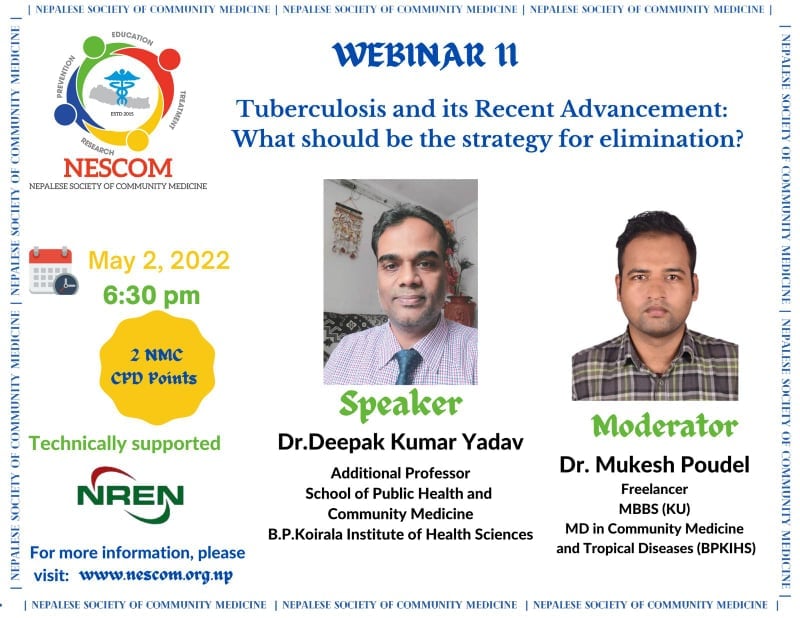
11th Webinar on Tuberculosis and Its Recent Advancement: What should be the strategy for elimination, May 2 2022

Summary:

Tuberculosis (TB) has been present since ancient times and still has significant burden worldwide. Even with availability of antibiotics and anti-tubercular drugs that have proven high efficacy the control of disease has been tough. In addition, Multidrug-resistance (MDR) and Extensively drug resistant (XDR) Tuberculosis has brought additional challenge for the health system. To end TB by 2030, we need innovative and effective intervention that are backed up by advancement in the field of prevention control and management.

Brief Background:

The proceedings of the webinar was started by Master of Ceremony, Dr. Rajiv Mani Adhikari where he introduced the speaker Dr. Deepak Kumar Yadav and the moderator Dr. Mukesh Poudel. Dr. Yadav works at School of Public health & Community Medicine, B.P. Koirala Institute of Health Sciences, Dharan as a faculty since 2008. He holds various positions in different National and International bodies in Nepal and has received awards for his contribution in field of Tuberculosis control. He is currently working in the Multinational Project: Antimicrobial Resistance and Labor Migration across Healthcare Boundaries. Dr. Poudel who was the moderator of the program currently works at the Consultant for development of National Aviation Public Health Emergency Preparedness Plan. He has previously worked as a Specialist Doctor in Ministry of Social Development, Bagmati Province and in Epidemiology and Disease Control division, Department of Health Services, Nepal.

The presentation started with the justification of topic,Tuberculosis and its recent advancement: What should be the strategy for elimination?, by Dr. Yadav where he focused on how TB has been present in the community as a fatal disease since ancient time and even with availability of effective treatment how it still is one of the leading cause of deaths worldwide. He emphasized on TB being a major cause of burden of the disease on every individual of the world whether rich or poor and especially affecting the marginalized poor population. He further gave an insight on the global burden of TB epidemic followed by its burden in Nepal. Global milestones that was achieved and that are planned to be achieved to End TB was also highlighted. Different diagnostic tools that are currently used in Nepal for diagnosis of TB and drug susceptibility was also reiterated in the presentation. He then gave an overview of the TB control program in Nepal and its current status. The webinar also highlighted about drug resistance TB, causes, types and interventions for prevention. Finally, Dr. Yadav talked about National Strategic Plan strategies and how teamwork can help end TB as per the set targets.

The completion of the presentation was followed by ice-breaking Zoom polls focusing on understanding of the topic and about the Nepalese Society of Community Medicine (NESCOM). Some interesting questions were raised after the poll questions which the speaker answered with very much clarity and precision. The webinar lasted for 1 and half hours with 75 participants. The webinar ends with the concluding words by Dr. Rajiv Mani Adhikari (MC for the program) with the announcement of an upcoming webinar on “Sexual and reproductive health: adolescent friendly services center and its laws, implementation and challenges in Nepal” on 17th May, 2022.

Objectives of Webinar:

  1. To understand the global and regional  burden of TB in Nepal.
  2. To understand the current scenario of TB in Nepal.
  3. To update on the latest diagnosis and treatment of TB.
  4. To update knowledge regarding MDR-TB, patient support and strategy for TB elimination in Nepal.

Key points that came out during the discussion:

  1. TB is an ancient disease present since mid 1800s. It was historically known as Wasting disease and White plague
  2. TB was declared as a global emergency by WHO in 1993. Though it is said to be a disease of poverty affecting mostly young adults, worldwide people are suffering from this disease. Majority of TB deaths occurs in the developing world with more than half of deaths due to TB occurring in Asia
  3. Worldwide, it is one of the top 10 causes of death with 1.3 million deaths among HIV negative and an additional 3,00,000 deaths among HIV positive. Globally, 10 million develop TB disease with 90% affected being adults (aged more than 15 years) and 9% affected being HIV positive
  4. End TB strategy was introduced in 2015 with vision of ending TB in Nepal by 2050. Ending TB is defined as a decrease in incidence rate of more than 80% by 2030 and 90% by 2035 compared to 2015 baseline
  5. TB burden in Nepal is quite alarming with around 1,17,000 people with TB currently living in Nepal with majority of them in Madhesh Pradesh (23%), Bagmati Pradesh (23%) and Lumbini Pradesh (21%)
  6. Though many cases are being detected each year, still around 41,500 cases are missed annually. The diagnostic tools used for diagnosis of TB are microbiological tests- smear microscopy, Cartridge Based Nucleic Acid Amplification Test (CBNAAT), culture and supportive tests- chest Xray, Tuberculin skin test (TST), Interferon Gamma Release Assays (IGRA), cytology: Fine needle aspiration cytology (FNAC), histopathology: biopsy
  7. TB burden is much higher, almost 1.6 times higher than previously estimated. Due to efforts on TB epidemiology in Nepal, there has been an estimated annual reduction of TB incidence by 3% in the last decade which is better than the global annual decline rate of 1.5%-2% but needs to be accelerated to meet the End TB targets
  8. National TB control program in Nepal started in 1994 with Directly Observed Treatment Short-course (DOTS) strategy which was quite effective followed by the Stop TB strategy introduced in 2006 which was a total failure. This ultimately has effect on achieving the targets and indicators of End TB strategy introduced in 2016
  9. Nepal falls under the 2nd highest burden country for MDR-TB. Drug resistance is confirmed if growth of M. Tuberculosis is observed in cultures despite presence of adequate concentration of first line anti TB drugs. Though Drug resistance tuberculosis (DR-TB) can be due to microbial, clinical, or programmatic, it essentially is a man-made phenomenon
  10. Inappropriate treatment from healthcare providers, inadequate supply and poor quality of drugs or inadequate drug intake or poor treatment response of the patient all may lead to DR-TB. DR-TB can further be divided in different types which includes Mono-resistance, Rifampicin resistance, Poly-resistance, Multi drug resistance, pre-extensive drug resistance and Extensive drug resistance
  11. Five principle ways of intervention can be adopted to prevent DR-TB:
  • Early detection and high-quality treatment of drug-susceptible TB
  • Early detection and high-quality treatment of drug-resistant TB
  • Effective implementation of infection control measures
  • Strengthening and regulation of health system
  • Addressing underlying risk factors and social determinants
  1. To eliminate TB by 2025, National strategic plan has been put forward with strategies focused on Active case finding, TB co-morbidities, Private sector engagement, Drug resistant TB, Information Communication Technology (ICT) tools for adherence and monitoring, Preventive measures, Community engagement and Multisectoral response.

Point for the policy brief:

To End TB focus should be on Integrated, patient-centered TB care and prevention prioritizing research and innovation. Government of Nepal should implement bold policies and supportive system with strong Supervision, Monitoring and Evaluation to achieve the WHO End TB strategy

Points to be discussed in the executive committee:

1.Role of Nepalese Society of Community Medicine (NESCOM) for capacity building of Community Medicine residents and graduates for intensified research and innovation focused on Tuberculosis with experts in the field

2.Building partnership and cooperation with the National Tuberculosis Control Centre, Ministry of Health and Population, Government of Nepal in implementing TB control program

Conclusion:

Tuberculosis is still responsible for huge burden of communicable disease worldwide, in Southeast Asia and Nepal. If not intervened at this point of time, it will have huge impact in regard to mortality and morbidity of people with huge economical loss. Hence, it is necessary that the Government and Private health sector acts together with proper intersectoral coordination to eliminate this disease

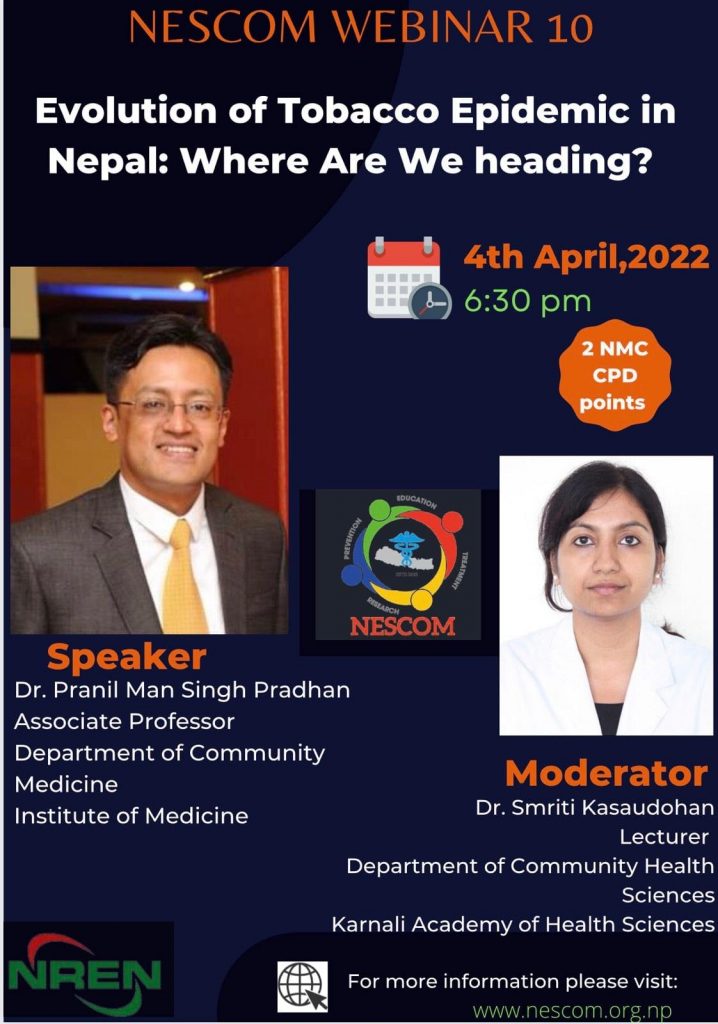
10th Webinar Summary Report on “Evolution of Tobacco Epidemic in Nepal: Where are we heading? 4th April,2022

Summary:

Tobacco epidemics is one of the biggest public health problems worldwide with Nepal being no exception. Various factors like higher age, low education, poverty, occupation (agriculture and unskilled work) have shown higher rate of tobacco use. Nepal having signed WHO Framework Convention on Tobacco Control (FCTC) in 2003 and implementing various Tobacco Control Acts and Strategy still have work cut out in controlling tobacco epidemics. The reason being the tobacco industry influence on tobacco control by taking advantage of unstable governments and corruption. Studies have shown that there has been decline in the prevalence of tobacco smoking in recent years. However, the use of smokeless tobacco products is in increasing trend in youth population. Hence, policies need to be developed in such a way that it is adolescent friendly. Nepal has achieved 3 measures of MPOWER strategy which includes 1. Protect people from tobacco smoke 2. Warn about the dangers of tobacco 3. Enforce bans on tobacco advertising, promotion and sponsorship. Proper monitoring of tobacco uses and implementation of prevention policies is need of an hour. Additionally, tobacco quit line and trained human resource to facilitate tobacco quitting needs massive revamp. Increasing taxation is highly cost-effective measure to decrease tobacco use. However, the big powerhouse industries need to be tackled well to develop those tobacco control policies. WHO report on Global tobacco epidemic 2021 have highlighted on the new and emerging tobacco products as a new challenge due to its misconception of being harmless and not contacting tobacco.

The session started with the quote by David Kessler that says “If public health is to be the center piece of tobacco control our goal is to halt this manmade epidemic – the tobacco industry, as currently configured, needs to be dismantled”. Dr. Pradhan gave a brief overview of trend of tobacco use over the years globally and in Nepal. He discussed on determinants of tobacco use with the results of various published studies. He then pointed out different legislations before and after Nepal signed WHO FCTC and implementation gaps including MPOWER strategies. He also focused on the challenges and scope of tobacco control. The completion of the presentation was followed by many interesting questions raised by the participants, making it an immensely interactive session. A zoom poll with 5 questions was also put forward after the end of discussions. The webinar lasted for nearly two hours. Dr. Pradhan was presented with the certificate of appreciation on behalf of NESCOM. At the end of the webinar the topic of the upcoming webinar was announced “Artificial Intelligence boon or destruction in Futuristic Diagnostic Medicine and Public Health: Where are we heading?”

Objectives of the webinar: 

  1. To understand the trend and burden of tobacco epidemics in Nepal
  2. To understand the determinants of Tobacco smoking in Nepal
  3. To understand the policy-implementation gaps in tobacco use among Nepalese population
  4. To know various new and emerging smoke free tobacco products
  5. To understand the challenges and future scope of tobacco control in Nepal

Key points discussed:

  1. Trend of tobacco use worldwide and in Nepal
  2. There has been reduction in use of tobacco, however use of smokeless tobacco among youth population has increased
  3. Studies have shown that higher age, low education, poverty, occupation (agriculture, unskilled workers), urban areas, Terai residents have higher rate of tobacco use
  4. In 1992, executive order restricting smoking in public places and taxation on tobacco products was placed in Nepal
  5. In 1993 taxation on tobacco products was implemented with the establishment of NHEICC (National Health, Education, Information and Communication Centre)
  6. In 2003 Nepal signed WHO FCTC convention which was ratified in 2006. Tobacco Product (Control and Regulatory) Act was implemented in 2010
  7. Article 11 of Tobacco Product (Control and Regulatory) Act states that “No person shall be allowed to sell and distribute or provide the tobacco products for free to a person below 18 and to the pregnant woman. In case the seller wants to be sure about the buyer to sell tobacco products, the seller may ask for necessary proof to verify the age and shall be the obligation of the buyer to provide such evidence.” It also states that “no person shall be allowed to sell tobacco products within the span of 100-meter distance from educational and health institutions, child welfare homes, child care centers, elders’ care home and other public places prescribed by Government of Nepal”
  8. MPOWER strategy is based on provision of WHO FCTC to reduce the overall Tobacco demand. Nepal has achieved three out of six measures of MPOWER strategy, whereas the other three strategies which needs to be achieved are to Monitor tobacco use and prevention policies, Offer help to quit tobacco use and Raise taxes. Political instability or conflict, corruption, and influence of tobacco industries in tobacco control policy have significant negative effects on tobacco control
  9. Studies have shown that there has not been proper implementation of some Tobacco control and Regulatory acts. According to a qualitative study published in Journal of NHRC on compliance of tobacco control law implementation, against the law there has been sale of tobacco products to children and establishment of tobacco vendors very close to school areas
  10. Government of Nepal has not been able to establish national level of quit line strategies. Chances of quitting is two times more with professional support and cessation services
  11. NDRI (Nepal Development Research Institute) report have shown that Nepal has one of the lowest taxation rates in South East Asia Region (30%). Also, the amount of health hazard taxes generated goes under curative but not on preventive aspect
  12. In 2015 Nepal was presented with the Bloomberg Award for Global Tobacco Control in recognition of its new law on graphic health warnings for tobacco packaging. Covering 90 percent of the surface area of tobacco packs, it has the largest warning labels in the world.  However, the VAT stickers over warning signs, unclear pictures on the packets has reduced the compliance of the warning
  13. Interventions for people wanting to quit tobacco are toll free quit lines- reactive and practice, text message support, chatbots (WHO Quit Program and WhatsApp and Viber), mobile apps, artificial intelligence, digital health worker and pharmacotherapy for nicotine dependence
  14. WHO report on the Global Tobacco Epidemic, 2021 addressing new and emerging tobacco products are aggressively marketed as ´safer´ and ´smoke free´. But they are still addictive and not without harm. One of the main risks of these new products is that, once the people take these products it will increase the risk of that person taking up smoking habit in the future
  15. E-cigarette has no direct tobacco but has nicotine derived from tobacco added in E-liquid, it is vaporized with charge and don’t generate any smoke. Heated Tobacco product heats tobacco unlike conventional cigarette smoking which burns tobacco

Points for the policy brief:

  1. Increasing taxes is a highly cost-effective measure to decrease tobacco use (10% tax increase leads to 4% decrease in consumption)
  2. Adolescent centered policies to protect the youth from taking up tobacco products
  3. Proper surveillance of Tobacco control and regulatory acts and reduce the policy – implementation gaps
  4. Government has yet to address on the rampant sales and advertisement of online tobacco products

Points to be discussed in executive committee:

  1. Role of Nepalese Society of Community Medicine (NESCOM) and Community Medicine graduates in control of Tobacco epidemics
  2. Mechanism of coordination, collaboration with public, private and international agencies

Conclusions:

Tobacco epidemics is a very essential topic that needs to be addressed. Although there is Tobacco Control and Regulatory act in papers, proper surveillance and monitoring of its implementation is still lacking in Nepal. Higher prevalence of tobacco consumption among the illiterate, poor, older people and those with agricultural and unskilled workers illuminates the target groups that need to be targeted while designing and implementing tobacco control interventions. Proper advocacy among stakeholders, increasing taxation, adolescent centered polices and researches on effective intervention are must for controlling Tobacco epidemics in Nepal

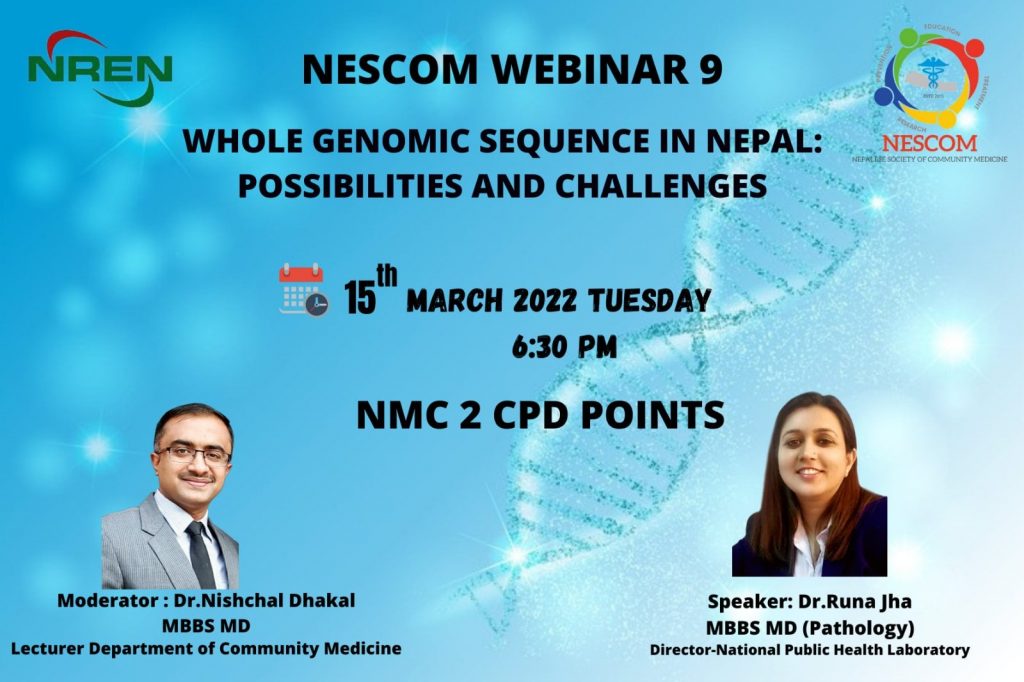
9th Webinar Summary Report on “Whole Genomic Sequencing in Nepal: Possibilities and Challenges, March 15th 2022

Summary: ­­­

Whole genome sequencing (WGS) is a comprehensive method of analyzing the entire DNA sequence of an organism’s genes. It is a laboratory process that is used to determine nearly all of the approximately 3 billion nucleotides of an individual’s complete DNA sequence, including non-coding sequence. In Nepal, the National Public health laboratory has started performing whole genome sequencing tests in its own laboratory from the government sector for tracking properties of the virus. This technology was set up with financial assistance from the World Health Organization.

Brief Background:

The Master of ceremony, Dr. Swikriti Koirala initiated the webinar with the introduction of the speaker Dr. Runa Jha and the moderator Dr. Nishchal Dhakal. Dr. Jha is the Director of the National Public Health Laboratory and current President of Association of Clinical Pathologists of Nepal. She received her postgraduate degree in Pathology from Institute of Medicine, Tribhuwan University. She also has worked as Faculty in Department of Pathology at Institute of medicine for 10 long years and got promoted to Associate Professor and then moved to Government Service as Chief consultant Pathologist. Her contribution in the field of laboratory works during this ongoing COVID-19 pandemic is unforgettable, for which she was selected by UN women to feature as “one of the five women on the front lines of COVID-19, COVID response” in April, 2020. She was appointed as an Ambassador for Peace by Universal Peace Federation in March, 2021. She was also selected by WHO SEARO to share video space with women leaders in Health in South East Asia on occasion of International Women’s Day 2021. Dr. Dhakal is currently working as a lecturer in the Department of Community Medicine in Nepal Medical College. He has worked as trainer for WHO/EDCD for contact tracing and case investigation and also was a part of the contact tracing team during the very early stage of COVID-19 pandemic. He is WHO/EDCD trainer for Epidemic and Pandemic Preparedness and Response training program.

The session started with the introduction of the topic, Whole Genome Sequencing in Nepal: Possibilities and Challenges, by Dr. Jha. She then gave a brief history of sequencing along with some interesting facts. She enlightened the diverse applications of WGS in clinical medicine and their different types. She further discussed about sequencing process and their challenges in context of Nepal. She then shed some light upon the conceptualization, establishment and functioning of Genetic Consortium in Nepal. Last but not the least, she talked about issues and challenges they faced and possible solutions and future plans regarding strengthening genetic research.

The presentation was wrapped up with few questions raised by the participants.Five questions zoom poll was put forward in regard to the presentation and understanding the society. The webinar lasted for about 2 hours with 100 participants and ended with the announcement of an upcoming webinar on “Evolution of Tobacco Epidemic in Nepal: Where are we heading?

Objectives of Webinar:

  1. To understand molecular and bio-informatics principle for sequencing
  2. To understand commonly used technologies for sequencing
  3. To understand commonly used data formats and bio-informatics methods for analysis of sequence data

Key points that came out during the discussion:
1. Whole genome sequencing can be used in
a. Molecular characterization
b. Pharmacogenomics
c. Population screening for disease risk
d. Prenatal screening
e. Individualization of treatment
2. There are first generation, second generation and third generation sequencing. First-generation methods enabled sequencing of clonal DNA populations. The second-generation massively increased throughput by parallelizing many reactions. Third-generation methods allow direct sequencing of single DNA molecules.

3. The facility established in National Public Health Laboratory is a Nanopore DNA sequencing machine which is small and cost effective.
4. Nepal sent the samples in early days of pandemic for genetic sequencing from WHO Nepal through coordination with WHO Regional Office for South-east Asia and headquarters facilitated to provide genetic sequencing service through the WHO laboratory at School of Public Health, Hong Kong, Special Administrative Region of China, under the global Influenza Surveillance and response system (GISRS).
5. To further increase the number of genomes sequenced and reduce the turnaround time, WHO also facilitated a collaboration between National Public Health Laboratory (NPHL) and the New Delhi-based Institute of Genomics and Integrated Biology (IGIB) resulting in the country sequencing around 50 genomes per month.
6. A second collaboration between NPHL and the New Variant Assessment Platform (NVAP) at UK health Security Agency (previously known as Public Health England UK) has now enabled the country to sequence around 150 genomes per month.
7. The National Genetic Consortium was conceptualized on February 17, 2021. Three committees were formed by MOHP: National Genetic Consortium, Technical Working group and steering committee.
8. Setting up of this consortium is a step in the right direction towards enhancing surveillance and detection in the country and ultimately contribute to strengthening the health system towards being better prepared to respond to emergencies and outbreaks of any type.
9. The facility will enable the country to do genomic surveillance of other pathogens including Influenza Virus; antimicrobial drug-resistant bacteria; Mycobacterium tuberculosis; Plasmodium species (Malaria parasite); and zoonotic, high threat, and emerging pathogens. Further, it will help the country to rapidly identify and/or confirm high threat pathogens of public health concerns including hither to unknown pathogens.
10. The consortium enabled Nepal to detect and confirm the latest SARS-CoV-2 variant of concern, Omicron, in the country with an impressive turnaround time of five days.
11. The biotechnology department of Tribhuvan University, the Dhulikhel Hospital, Epidemiology and Disease Control Division, Central Veterinary Laboratory, Nepal Academy of Science and Technology (NAST), Walter Reed/AFRIMS Research Unit Nepal (WARUN) and WHO Country Office for Nepal are the members of the consortium.
12. Several Ethical and practical challenges and dilemmas were identified associated with WGS including
i. Revelation of “off-target” mutations
ii. Many revealed disorders will have no prevention or treatment
iii. Revelation of nonpaternity, consanguinity, incest.
iv. Costs of genetic counseling and follow up
v. Possible forensic uses of data
vi. Data storage and privacy
vii. Huge number of novel missense variants

Points for the policy brief:

To develop Whole Genome Sequencing at advanced level there needs dedicated and trained human resources with establishment and strengthening of bioinformatics unit at NPHL. Collaboration and Coordination with different National and International Laboratories is paramount to strengthen the network. Extending sequencing for other pathogens is needed in the longer run.

Points to be discussed in Executive committee:

Role of Nepalese Society of Community Medicine (NESCOM) and Community Medicine Graduates in Genetic research

Conclusion:

WGS have the capacity to greatly enhance knowledge and understanding of the infectious disease and clinical microbiology. Given current resources and infrastructure limitations, WGS is most applicable to use in Public health laboratories, reference laboratories and hospital infection control laboratories. Although genomic technologies are rapidly evolving, widespread implementation in clinical and public health is limited by the need for standardized quality control and data interpretation, bio- informatics, expertise and infrastructure.