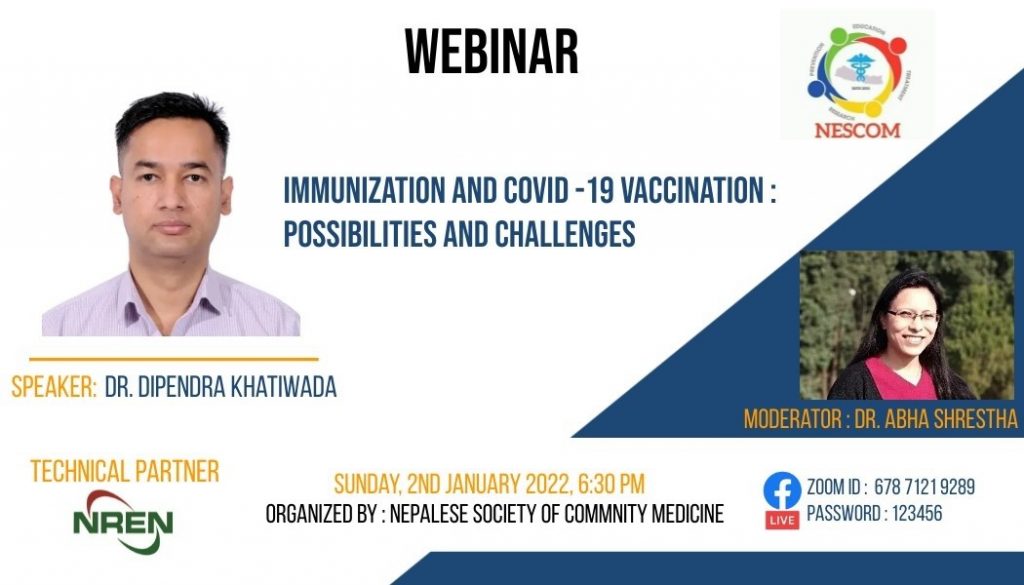
3rd Webinar Summary Report On “Immunization and COVID-19 Vaccination: Possibilities and Challenges”, Jan 2, 2022

Summary:

Vaccinations have undoubtedly proven to be a boon to public health since its introduction to mankind. It is a key component of Primary Health Care in any nation and is considered as one of the best investments. Immunization is a successful priority one program (P1) of the Government of Nepal. Since its inception on 2034 B.S, the National Immunization Programme (NIP) has met several milestones and it has now expanded with Rota virus vaccine from July 2020. It plans to include Typhoid vaccine in 2022. The unforeseen Pandemic which started on December 2019 has caused a lot of havoc but the COVID-19 vaccinations are a major breakthrough in the field of immunization. A number of vaccines have been developed in the fight against COVID under Emergency Use Listing (EUL) till now. However, there are still many challenges in terms of vaccination coverage, accessibility and equity which can only be solved with multisectoral collaboration and partnerships among different stakeholders.

Brief Background:

The proceedings of the webinar was started by Master of Ceremony, Dr. Nikita Bhattarai. Dr. Bhattarai started with the introduction of the speaker Dr Dipendra Khatiwada and the moderator Dr. Abha Shrestha. Dr Khatiwada is a Surveillance Medical officer (SMO) and is supporting the immunization unit in WHO-IPD Central Office. He is also supporting the National immunization program including the current COVID-19 vaccination campaign. Dr Abha Shrestha is a lecturer in Kathmandu University School of Medical Sciences (KUSMS) and a coordinator at Nepal NCDI poverty commission; she is currently involved in the home-based isolation care of COVID-19 patients and the vaccination program.

The webinar started with a brief overview of COVID-19 including the present scenario of COVID-19, number of cases, vaccination status and trends globally and nationally. The current situation of the neighboring country (India)  and its vaccination coverage status was also discussed as it has direct implications in Nepal due to its open border. Dr. Khatiwada discussed different vaccines given by the Government of Nepal as part of the immunization program. However, his presentation was mostly focusing on COVID-19 vaccines and the COVID-19 vaccine under development around the world and its significance. He briefed about the hurdles faced on the coverage, hesitancy of vaccination in Nepal. The completion of the presentation was followed by many interesting questions raised by the participants making it an immensely interactive session. A 5 question zoom poll was put forward in discussions. The webinar lasted for nearly about 2 hours with 47 participants and ended with the announcement of an upcoming webinar on “Establishing and conducting clinical trials in Nepal.”

Objectives of Webinar:

  1. To understand the importance of immunization for disease prevention and control.
  2. To know the status of COVID-19 vaccination globally and nationally.
  3. To know the hurdles and gaps prevailing in the delivery of COVID-19 vaccinations in terms of coverage, equity and accessibility.

Key points that came out during the discussion:

1. Evidences have shown that immunization alone prevents 2-3 million deaths annually as vaccinations have been developed for more than 20 different diseases

2. It is a best investment for the future producing a healthy return i.e. 1$ spent on immunization gives back $16 in return

3. Immunization has been addressed by the Constitution of Nepal as well as Immunization Act 2072 as an individual human right of every Nepali citizen

4. Nepal started its Expanded Programme on Immunization (EPI) starting initially with BCG and slowly expanded to DPT and scaled up nationally. Subsequently, it added more vaccines to the schedule such as OPV and pentavalent vaccine. Several other vaccines including Typhoid Conjugate Vaccine (TCV) and Human Papilloma Virus (HPV) vaccine are planned for introduction in Nepal in near future

5. Normally vaccines are authorized for use among general population only after they have passed through 4 phases of clinical trials. Any vaccine before its use undergoes  series of rigorous scientific experiments and tests, taking 5-6 years duration on an average. While, due to the COVID-19 Pandemic, COVID-19 vaccines have been developed quite quickly in just around 1 year duration of testing and trials to fulfill the demand of time and need. It is the matter of great pride that scientist around the world have spent day and night to make this happen.

6. The COVID vaccines have been authorized only as Emergency Use Listing (EUL) and not as a routine schedule and 9 countries in the world have been authorized for vaccine development so far.

7. The urgent need of protection of the people in the country, its safety and demand led to the prioritization of the vaccine receiving groups. The first prioritized group was the frontline health care workers; it was not only to protect the HCWs but also to encourage people in the country to get vaccinated and to assure safety. Therefore, the second prioritized groups were the elderly population and those with co-morbidity and priority three groups were the general population.

8. There was lots of buzz for booster doses for COVID -19 in many countries and Nepal was also planning for the same for people who have completed two regular doses of vaccines as recommended by WHO-SAGE (Strategic Advisory Group of Experts). However, a full-fledged recommendation from the government is yet to come.

9. Currently discussion is going on regarding homologous vs. heterologous immunization, its benefits and efficacy. However, WHO recommends immunizing with homologous vaccines as far as possible and switching to heterologous series only in case of unavailability of vaccines but the choice again depends solely on individual country contexts and standards.

10. There were discussions regarding the age group to be vaccinated and pediatric vaccination policies. Currently the approved age group for vaccination  is above 18 years of age. However, there is gradual addition of younger age groups as many countries have started trials among those below 18 years of age. So far, Pfizer has been listed safe for the 12-17 years of age and other vaccines are on the pipeline.

11. Sinopharm vaccine is under trial with an objective of vaccinating >3 yrs aged children. Similarly, in Cuba and Venezuela, vaccines are under trial for vaccinating >2 years aged children.

12. The reasons for differences in vaccine coverage includes the lack of adequate availability of vaccines and trained manpower, budgetary issues, inability to expand vaccination session sites, hesitancy among general population, preference between different vaccines among people, misinformation regarding vaccines in social media, difficult geographical terrain creating difficulties in accessibility to certain areas, pitfalls in recording and reporting aspects and lack of proper orientation and training to the staffs for data entry.

Point for the policy brief:

To enhance the COVID-19 vaccination a joint collaboration between various countries and stakeholders as well as national and international agencies is paramount. This action needs to be backed with strong health infrastructure, the availability of adequate vaccine stocks in order to reach every single individual. Additionally, trained manpower and information systems need  to be strengthened for the efficient delivery of the vaccine.

Points to be discussed in the executive committee:

Role of Nepalese Society of Community Medicine (NESCOM) in involving and utilizing the knowledge and skills of MD students and young graduates in the various aspects of immunization. It could be in the area of technical expertise, policy making, service delivery, monitoring and evaluation and research purposes.

Conclusion:

Immunization is a cost-effective tool to curb the COVID-19 pandemic. To make it a reality, the program needs to emphasize on universal coverage, equity and to increase accessibility to vaccines. The focus should be to clear misconceptions of the general public to reduce vaccine hesitancy. The health sector should be strengthened and health workers should be effectively trained for delivery as well as for strengthening the information system.
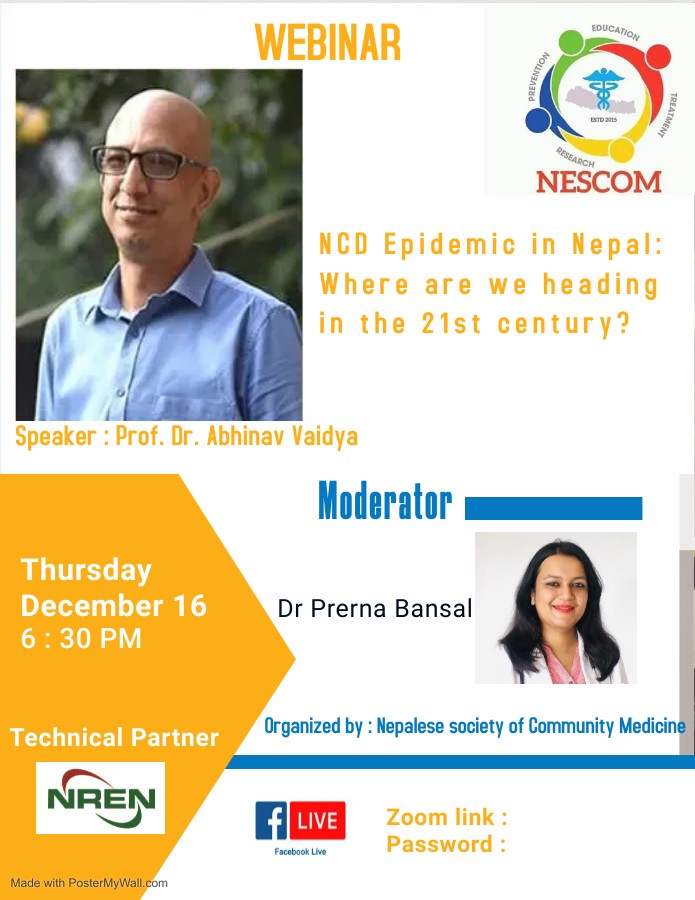
2nd Webinar Summary Report On “NCD’s Epidemic in Nepal: Where Are We Heading in the 21st Century?”, Dec 16th 2021

Summary:

There is no disagreement that NCDs are in rising trends in Nepal. However, it cannot be epidemiologically declared that it is an epidemic in Nepal. Various reports, action plan are produced nationally and internationally for the prevention of NCD’s. However strong political commitment, advocacy and evidence generation is needed to counter the aftermath of NCD in Nepal. Multidisciplinary collaboration is the need of an hour. Effective implementation and scaling of PEN and PEN Plus program in all the 7 provinces of the country is a key to reduce the burden of NCD in Nepal.

Brief Background:

The proceedings of the webinar was started by Master of Ceremony, Dr. Nikita Bhattarai where she read out the bio of the speaker Prof. Dr. Abhinav Vaidya and the moderator Dr. Prerna Bansal. Prof. Vaidya currently works at Kathmandu Medical College and is the faculty in the Department of Community Medicine since 2006. He holds various positions in different national and international bodies and has contributed significantly to NCD Prevention in Nepal. Dr. Bansal who was the moderator of the program currently works at the College of Medical Sciences (COMS) in Chitwan District in Central Nepal. She played an instrumental role working as a focal person during the COVID-19 Pandemic in Chitwan and supported the Government of Nepal in coordinating various activities for COVID-19 Prevention.

The presentation started with the justification of topics (NCD Epidemic in Nepal: Where are we heading in the 21st Century?) by Prof. Vaidya where he emphasized that it is difficult to say epidemiologically that NCD is really an epidemic in Nepal. He gave a brief overview of the prevalence of major NCDs in Nepal and also discussed various documents related to NCD developed in Nepal (Lancet Commission Reports, STEPS Survey, etc.) He briefed about the different policies documents released by the Government of Nepal since 1991 and also the action plans for NCDs nationally and internationally. NCD services continuum of care and best buys for NCDs were also highlighted by Prof. Vaidya. Additionally, he talked about the various documented community intervention in Nepal which includes the HARDIC trial, COBIN trial, the BISHES study, Dhulikhel heart study and the Cohesion Study. He further added on various health intervention programs such as PEN, PEN plus program, Mutu program. He talked on issues of health financing, universal health coverage and sustainable development goals in NCDs. He reiterated that NCDs advocacy in Nepal is sporadic and non-inclusive. He also mentioned on the importance of research in NCDs and talked about increasing the quality of papers.  He concluded with remarks on adequate opportunities for NCD to the young community medicine graduates in Nepal.

The completion of the presentation was followed by ice-breaking zoom polls focusing on understanding about Nepalese Society of Community Medicine (NESCOM). Some interesting questions were raised after the poll questions which the speaker answered with very much clarity and precision. The webinar lasted for 2 hours with 61 participants. The webinar ends with the concluding words by Dr. Nikita (MC for the program) with the announcement of an upcoming webinar on “Immunization and COVID-19 Vaccination: Possibilities and Challenges on 2nd January 2022.”

Objectives of Webinar:

  1. To understand about the situations of NCD in Nepal.
  2. To understand about the direction of NCD prevention in Nepal.

Key points that came out during the discussion:

  1. Non communicable diseases (NCD’s) is a rising problem in developing countries like Nepal. Quality research should be produced to design interventions relevant to the context.
  2. Factors responsible for the increase in NCD’s are tobacco use, unhealthy diets, low physical activity, use of alcohol with air pollution being a new addition.
  3. The Nepal NCDI Poverty Commission reports shared a data about burden of disease from NCD’s and injuries (1990-2015), which showed that NCD’s cases and injuries seems to be going up where as the communicable diseases has shrunk.
  4. According to the recent data in Nepal the mortality due to NCD is rising having prevalence of more than 70%. However, the funding is very low compared to the burden of the disease.
  5. NCDs has been in rising trend in Nepal and the recent policy is to strengthen national capacity, leadership, governance and research. However, the quality of research needs more refinement.
  6. The global action plan 2013, was the basis on which the South East Asian goals and targets came up. It was a historic moment when Nepal first came up to address its NCD’s issues.
  7. In multi-sectorial NCD action plan (2014-2019), there was an inclusion of 3 diseases (Oral health, Mental health, Road Traffic injuries) and addition of one risk factor (indoor air pollution).
  8. In the reflections and learnings from Multi-sectoral NCD Action plan 2014-2020 there is the need of commitment from the top political level. Hence, the upcoming action plan should add on establishment of NCD division at MOHP, mainstreaming of NCD related programs in the line ministries, adequacy of trained man power in the provincial and local level.
  9. Tobacco, alcohol, unhealthy diets and physical activity are still some of the major risk factors for NCDs which needs to be addressed in Nepal.
  10. NCD Services: PEN package is a key programme for the NCD prevention in the country at the moment. It has 4 protocols and has been gradually scaled up across different parts of the country. Protocol 1 addressed on HTN, DM, prevention of heart attacks, stroke and kidney disease. Protocol 2 talks on health education and counselling on healthy behavior, Protocol 3 is on COPD diagnosis and treatment and Protocol 4 is on the assessment of breast and cervical cancer and its appropriate referral.
  11. PEN plus program is an integrated strategy that builds on existing PEN program to increase the quality of services and decentralization for severe NCDs at primary referral facilities.
  12. The relationship between economy and NCD’s is a complicated one as the cases of NCD is rising which has proportionate effect on the economy, health system, households, families. This in turn has financial pressure in all sectors. The poor are more affected by NCD’s like IHD, asthma, COPD, Hemorrhagic stroke, Rheumatic heart disease.
  13. In Nepal, one third (36%) of health expenditure is due to NCD’s. Hence UHC should be achieved by including additional services, reducing cost sharing and fees and out of pocket expenditure.
  14. 4% of total government health expenditure is for NCD’s in Nepal.
  15. NCD’s research in Nepal has taken up. Within the last five years various form of research work such as secondary data analysis, systematic review and meta-analysis, system research, policy analysis, implementation research and digital intervention has been done.
  16. Advocacy efforts need to be streamlined and amplified. Multidisciplinary health care workers along the different government bodies need to be aligned in one pathway to reduce the burden of NCD in Nepal.

Point for the policy brief:

To push back NCDs, Nepal needs adequate manpower trained in NCD prevention at various levels (NCD Champions). The government of Nepal should involve Community Medicine graduates in various capacities to generate evidence for NCD prevention and scaling up the PEN and PEN Plus programs.

Points to be discussed in the executive committee:

  1. Role of Nepalese Society of Community Medicine (NESCOM) for capacity building of Community Medicine residents and graduates for the prevention of NCDs in Nepal.
  2. Building partnership with the Government of Nepal in implementing PEN and PEN Plus Program in all the 7 provinces of the country.

Conclusion:

NCD’s are in a rising trend in Nepal. If not controlled it will have a huge burden on the health system in the upcoming days. Various context-specific health promotion and preventive strategies need to be developed. A high level of political commitment and strong advocacy is needed for its prevention.

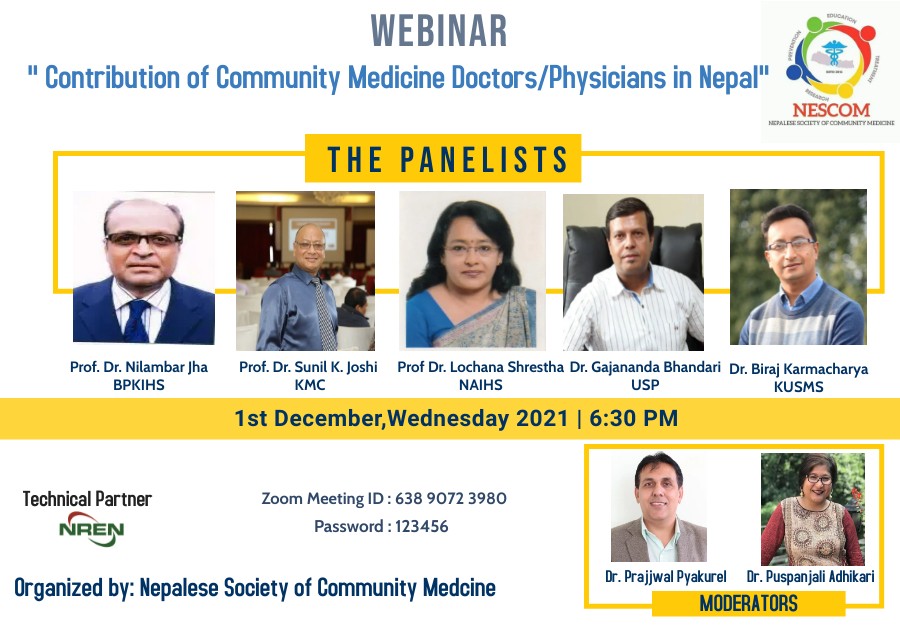
1st Webinar Summary Report on “Contribution of Community Medicine Physicians Doctors in Nepal”, Dec 1 2021

Summary:

There was common consensus among panelist that Community Medicine (CM) is a multi-displinary field that covers all aspects of health system. The graduates of CM have strong clinical as well as public health background. However, the graduates should be proactive, create and seize new opportunities to make the field recognized at national and international level. The scope of the field is large and the COVID-19 pandemic has only created more opportunities and demands. Constant lobbying at the health system level is needed to strengthen the subject and the fraternity. Multi-institutional collaboration with training and resource sharing is needed to enhance the capacity of CM graduates. Institutional leadership in combination with institutional policies, structure and process is crucial for development.

Brief Background:

The proceedings of the webinar started with the speech from Prof Dr. Lochana Shrestha, President of Nepalese Society of Community Medicine of Nepal (NESCOM) followed by a speech from the  General Secretary Dr. Dipesh Tamrakar. The duo appreciated the initiation of webinar series and congratulated the entire team for their hard work. It was then followed with the introduction of the panelist by Dr. Nikita Bhattarai (Master of Ceremony for the Program). The webinar had 5 panelists, Prof. Dr. Nilambar Jha, Prof Dr. Lochana Shrestha, Prof. Dr. Sunil Kumar Joshi, Dr. Gajananda Bhandari and Dr. Biraj Man Karmacharya who represented different academic institutions and international organization in Nepal. The moderation of the program was done by Dr. Prajjwal Pyakurel and Dr. Pushpanjali Adhikari (both were the executive committee of NESCOM). There was an extensive discussion about different aspects of Community Medicine subjects with positive note given by all the panelist. The webinar lasted for about two hours and there were 75 participants during the webinar.

Objectives of webinar:

  1. To have the viewpoint of different panelist on CM as a subject and the role of the CM graduates in the current health system
  2. To understand the skills needed besides books to sustain as a CM graduate in Nepal
  3. To figure out the grooming culture, mentor, mentee relationship during pre-service training of CM in Nepal

Key Points that came out during the  discussion:

  1. Government placement of CM graduates in the health system is crucial for the development of the subject and the fraternity. Vacancies should be opened for the CM graduates through Public Service Commission.
  2. Flexible academic training curriculum with exposure in real field settings is needed for the field to develop and interest of the candid should be prioritized
  3. There should be broader understanding between different institutions to create a model of excellence of multinstitutional collaboration. Institutional leadership is key to make this happen.
  4. Opportunities for the CM graduates are plenty. However, one should be innovative, creative and seize the opportunities to establish oneself in the health system
  5. Working in the international projects helps to be groomed as an independent researcher

Point for the policy brief:

  1. CM is a subject which touches majority of the aspect of the health system and covers both the clinical as well as public health. The graduates of CM should be utilized by the government through Public Service Commission in building government institutional capacity and involve them as Community Physicians, Teacher, Trainer, Researcher and Leader to utilize their potential in the health system of the country.

Points to be discussed in the executive committee:

  1. Mechanism of creating multinstitutional collaboration for teaching, learning, research and trainings
  2. Lobbying for the placement of CM in Public Service Commission, Government of Nepal
  3. Development of innovative model of practice of CM

Conclusion:

The webinar was fruitful which covered all the objective set. There was firm conclusion that CM graduates has plenty of opportunities. However, one needs to be innovative, creative and seize opportunities and accept challenges to succeed at highest level.

World Elderly Abuse Awareness Day, June 18 2021


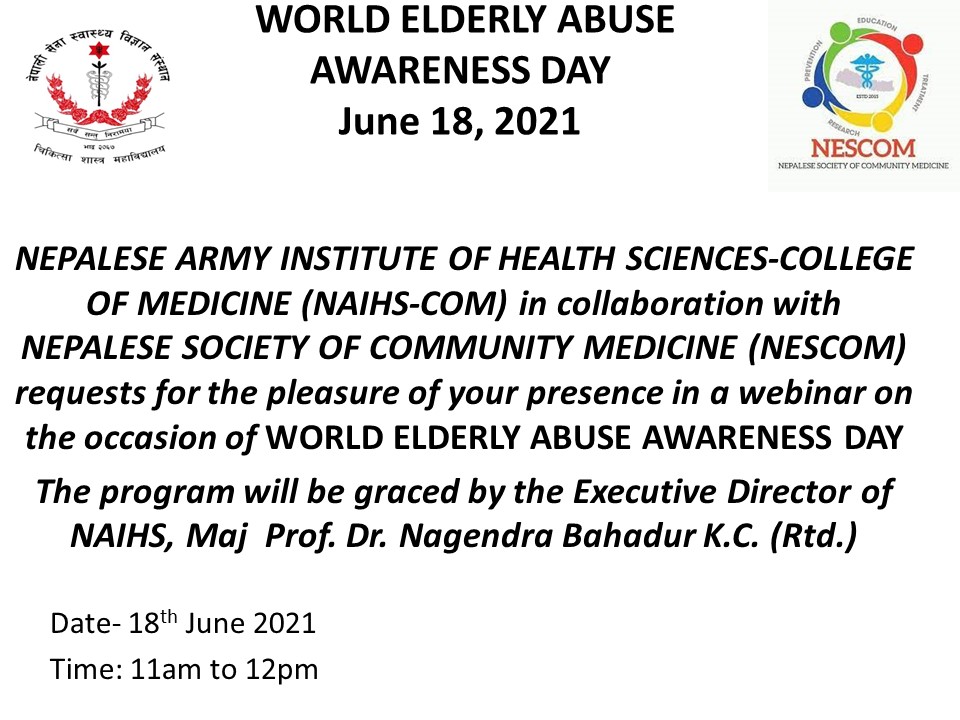
NEPALESE ARMY INSTITUTE OF HEALTH SCIENCES-COLLEGE OF MEDICINE (NAIHS-COM) in collaboration with  NEPALESE SOCIETY OF COMMUNITY MEDICINE (NESCOM) requests for the pleasure of your presence in a webinar on the occasion of WORLD ELDERLY ABUSE AWARENESS DAY

The program will be graced by the Executive Director of NAIHS, Maj  Prof. Dr. Nagendra Bahadur K.C. (Rtd.)

Date- 18th June 2021

Time: 11am to 12pm