
Summary:
Brief Background:
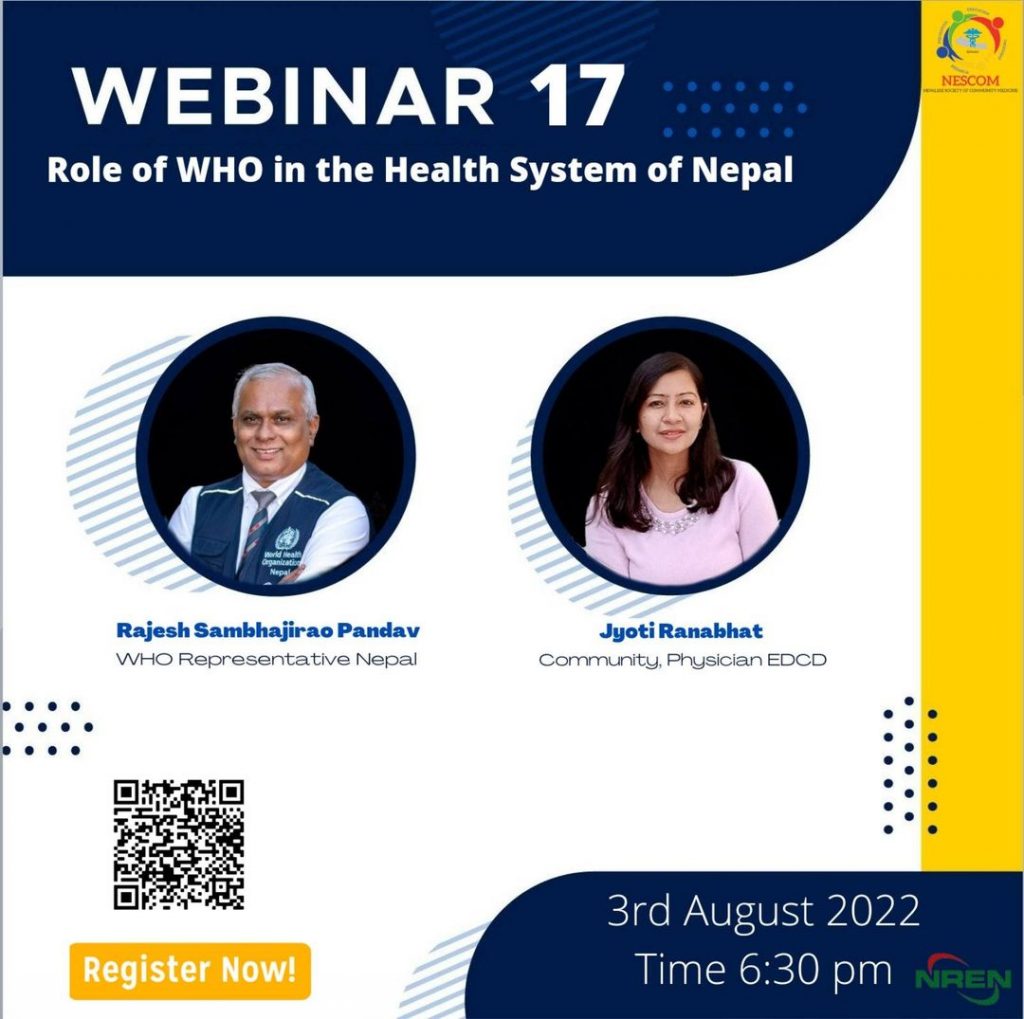
The proceedings of the webinar was started by Master of ceremony Dr. Baidehi Upadhya where she introduced the speaker Dr. Rajesh Sambhajirao Pandav and the moderator Dr. Jyoti Ranabhat.
Dr. Pandav is the WHO Representative to Federal Democratic Republic of Nepal. He has completed his MPH with major in Epidemiology from: Graduate School of Public Health, University of Pittsburgh, USA. He has previously contributed as a research officer and field coordinator international council for Control of Iodine Deficiency Disorders, New Delhi, India. He has also been awarded with many prestigious awards among which one of the significant awards is WHO director General’s award for excellence to WHO country office Timor-Leste for championing the ‘Walk the Talk’ initiative. He is a guest editor of the journal, International Review of Psychiatry, UK (2006).
Dr. Jyoti Ranabhat, the moderator of the program has recently graduated in MD – Community Medicine and is currently working as a Community Physician in Epidemiology and Disease Control Division, Department of Health services, Kathmandu, Nepal.
Dr. Pandav started the presentation by clearing the misconception that WHO is not an NGO but an international organization governed by its own executive bodies and policy which works with international organizations, foundations, advocates, local government and health workers. WHO has supported Nepal Health system for 60 years. He explained the strategic directions and core functions of WHO and the various program run through it. The motto of WHO at a glance “we deliver real-world impact to build healthier, safer world -” was highlighted by Dr. Pandav.
At the end of the presentation interesting zoom poll questions were welcomed focusing on understanding of the topic which the speaker answered with excellent, clarity and precision.
The webinar lasted for 1 hr. and 37 minutes, and at the end of the webinar session, on behalf of the Nepalese Society of Community Medicine (NESCOM) a certificate of appreciation was presented to Dr. Pandav. Around 90 participants were present during the webinar. The webinar ended with the concluding remarks by Dr. Baidehi Upadhya (MC for the program) along with the announcement of the upcoming webinar on Proposal writing on 20th August, 2022
Objectives:
- To understand the role of WHO in the health system of Nepal
- To know the target and impact by 2023
- To know the functioning and structure of WHO
Key points that came up during the discussion:
- International work done in collective for cholera epidemics in 1830 and 1834. The first international sanitary conference was convened in Paris in 1851
- Establishment of WHO after World War ll, 1945
- First world health assembly met in Geneva in the summer of 1948
- WHO’s constitution came into force in April 1945
- It has a functioning body which consist of 194 member states, six regions, a secretariat, an executive board and world health assembly which is the supreme decision taking body
- The world health assembly meets every year
- Major contributors of WHO budget (about 80%) are funded by the Member states, Volunteer contribution, UN agency, Philanthropist and other sources
- The main goal of WHO is the attainment by all people of the highest possible level of health
- They have developed a corporate strategy, which comprises of four strategic directions and six core functions which guides its work
- WHO at glance:
- Promotes health, keeps the world safe, and serves the vulnerable
- Puts science to work
- Responds to health emergencies
- Expands health coverage
- Promotes healthier lives
- Mobilizes every part of society to advance health and security of all
Four strategic directions are:
- Reducing excess mortality, morbidity and disability
- Promoting healthy lifestyles and reducing risks factors to human health
- Developing health systems that equitably improve health outcomes
- Responding to people’s legitimate with demands and are financially fair
Six core functions are:
- Providing leadership on global health matters
- Shaping the health research agenda
- Setting norms and standards
- Articulating evidence-based policy options
- Providing technical support to countries
- Monitoring and assessing health trends
Triple billion targets by 2023 consists of:
- People benefit from universal health coverage
- Better protected from health emergencies
- Better health and well-being
WHO mainly focuses on primary health care to improve access to quality essential services and the key areas of strategic focus are:
- Re-think preparedness, readiness and bolstering response, capacities to health emergencies
- Build resilience through primary healthcare-oriented HSS and health security nexus
- Advance WHO’s leadership in science and data
- Get back on track and accelerate towards the SDGs
WHO representative to Nepal administration support to Central:
- Health system strengthening
- Communicable disease
- WHO Health Emergencies
- Immunization preventable disease
- Non communicable diseases
Hence, WHO works only at the federal level. Due to request from Health Ministry of Nepal it has provided support to the province:
- Provincial Health officer
- Surveillance medical officers
- Field medical officers
- NCD and mental health officers
- Provincial sexual and reproductive officer
They also provide with:
- Advancing universal health coverage
- Effective delivery of priority public health programs
- Enhances health security, disaster preparedness and response
- Multi-sectoral engagement and partnerships for improved health outcomes
Points for the Policy brief:
WHO has been an immense contributor for the development of health system in Nepal. However, there is still a need of strengthening capacity in provincial and local level in different areas for better public health intervention which must be done for better functioning of health system
Point to be discussed in Executive Committee:
Role of Nepalese society of Community Medicine (NESCOM) in organizing interactive sessions for better understanding of WHO impact in Nepal’s health sector.
Conclusion:
WHO has been supporting health system of Nepal for 60 years. It has been an immense help in strengthening the health sector and capacity building of developing countries. It has been the main force of action around the globe in elimination and eradication of high impact communicable diseases, control of epidemics, pandemics or an outbreak of new diseases, vaccination and many more programs. It supports, targets, protects and serves the most vulnerable ones. It needs to strengthen the capacity planning and funding at municipal level for public health interventions as well as building a strong border collaboration policy to keep track of diseases since Nepal needs to eliminate many diseases.