
Summary:
Brief Background:
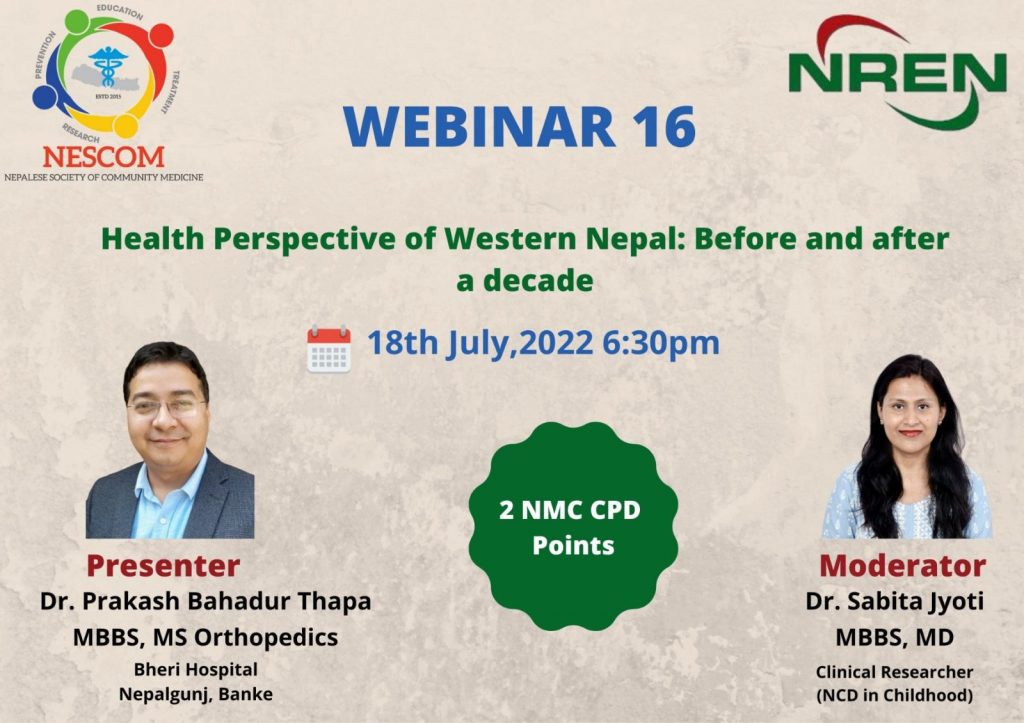
The master of ceremony – Dr. Achyut Neupane started the proceedings of the webinar by introducing the speaker, Dr. Prakash Bahadur Thapa, and the moderator, Dr. Sabita Jyoti. Dr. Thapa is currently working as an orthopedic surgeon in Bheri Hospital, Nepalgunj, Banke. He has completed a short-term fellowship in the spine from the Indian Spinal Injuries Centre, New Delhi, India. He has won a national award for best social contribution to the care and treatment of people living with HIV/AIDS in the far-western region of Nepal. Furthermore, Dr. Thapa was felicitated by the President of Nepal with the prestigious award, the Prabal Janasewa Shri (Chaturtha) Padak. He also received Barbara Foundation COVID-19 Special Award 2021.
Dr. Sabita Jyoti, the moderator of the program has recently graduated in MD community Medicine and is currently working as a clinical researcher (NCDI in childhood). Her field of interest is NCD (non-communicable diseases), maternal and child health, and infectious diseases.
Dr. Thapa started the presentation by briefing about Bheri hospital which serves as a major service provider for the people of provinces 5,6 & 7 (western Nepal). He highlighted the major problems related to inadequate health services in western Nepal. He shared the challenges faced during the COVID-19 pandemic and further informed about the establishment of health infrastructures such as PCR labs & COVID-19 help desks, local production of PPEs (Personal Protection Equipment), etc. Finally, Dr. Thapa addressed the areas that can be improved and policies that can be formulated to bring a positive change in health facilities in western Nepal.
The webinar lasted for 1 hour and 20 mins. On behalf of the Nepalese Society of Community Medicine (NESCOM), a certificate of appreciation was presented following the insightful presentation by Dr. Thapa. Around 80 participants were present during the webinar. The webinar ended with the concluding remarks by Dr. Prajjwal Pyakurel along with the announcement of the upcoming NESCOM webinar on “Vector-borne diseases and climate change” on 8th August 2022.
Objectives of the Webinar:
- To understand the health perspective of western Nepal: before and after a decade.
- To identify the major problems related to the inaccessibility of health facilities in western Nepal.
- To identify the major health issues that are prevalent in western Nepal.
- To share the health infrastructure establishment during a pandemic in the western part of Nepal.
- To update on the strategies being conducted & different policies needed to improve health services in western Nepal.
Key Points Discussed during the webinar:
- The coverage of Western Nepal includes three provinces namely provinces 5,6 and 7.
- The main reasons for the inaccessibility of health facilities in western Nepal are:
- The distance between health facilities and the community
- Lack of accessible roads in the provinces 6 & 7
- Poverty & illiteracy
- More prone to natural calamities
- Bheri hospital which is located in Nepalgunj, Banke is one of the major service providers for the people of provinces 5,6 & 7. It was established in 1947 BS as Prithvi Bir Hospital Dispensary. Currently, 350 beds are functional and it is in the process of being established as a 500 bedded specialized hospital. The specialized services include Cath lab, neurosurgery, dialysis, spine surgery, sports medicine, and arthroplasty treatment for sickle cell disease. Similarly, free health services are also provided by the hospital which include a Short-term Stay Unit (SSU), One-stop Crisis Management Center (OCMC), geriatric, sickle cell diseases, safe motherhood, safe abortion, family planning, and vaccination, and emergency health services for the non-affordable group. Cancer, cardiac diseases, renal failure, alzheimer’s disease, parkinson’s disease, head and spinal injury, sickle cell anemia, and stroke are covered under this program.
- During the COVID-19 pandemic, the local production of Personal Protective Equipment (PPEs), establishing PCR labs, fever clinics, and COVID-19 help desks were established to face the challenges. The patients were also kept in observation preparing a temporary shelter (tent) within the hospital. Sushil Koirala Prakhar cancer hospital in Khajura which was under construction was also utilized due to the overflow of patients. During the 2nd wave of COVID-19, the oxygen supply was limited, therefore, a liquid oxygen tank was built to meet the demand for oxygen.
- The main health issue of western Nepal is neglected trauma. The other issues are spinal cord injury, snakebite, HIV/AIDS, sickle cell anemia, fall injuries, and maternal and neonatal mortality.
- Sickle cell anemia is considered one of the major health problems. The prevalence of the disease is common in the Tharu community. More than 99% of the Tharu community had issues of sickle cell anemia. So, awareness regarding sickle cell anemia has been included in the textbook of classes 7 and 8. Along with Sickle cell anemia; Thalassemia is also common in the Tharu community.
- Non-Communicable diseases (NCDs) are a leading cause of morbidity and premature mortality in the world. Globally, 15 million people die prematurely due to NCDs annually and over 85% of these deaths occur in low and middle-income countries. World Health Organization (WHO) has identified NCDs as a major public health problem. NCDs pose a challenge in achieving the Sustainable Development Goals 2030 of reducing premature NCD-related mortality by one-third.
- Nepal PEN program: The Package of Essential Non-Communicable Diseases Program (PEN) was developed on a risk-based approach to be implemented in a low-resource setting in the Primary Health Care model.
- Multi-Sectoral Action Plan II (2021-2025):
- Goal: To reduce the burden of NCDs throughout Nepal.
- Objectives:
- To reduce risk factors for NCDs and address underlying social determinants.
- To raise priority accorded to the prevention and control of NCDs in the national agenda policies, and programs.
- To strengthen national capacity and governance to lead multi-sectoral action and partnership across sectors for the prevention and control of NCDs.
- To establish an NCD surveillance, monitoring, and evaluation system for evidence-based policies and programs.
- To strengthen health systems through the provision of people-centric, comprehensive, integrated, and equitable care for improved prevention and control of NCDs.
- Road Traffic Accidents (RTAs) are the leading cause of death for children and young adults aged 5-29 years. About 93% of all fatalities occur in low & middle-income countries. Approximately, 1.3 million people die each year in Nepal. More than half of all RTA deaths are among vulnerable road users.
- Globally, fall injuries are the second leading cause of unintentional injuries and death, after RTA. 80% of these fall injuries are in low- and middle-income countries. Each year an estimated 684,000 individuals die from fall injuries. Most of the cases of injuries occur in the adult age group of more than 60. 37.3 million fall injuries require medical attention each year. Prevention strategies should emphasize education, training, creating safer environments, prioritizing fall-related research, and establishing effective policies to reduce risk.
- Mental health is one of the prime subjects for the sustainable development of any community. Suicide is the fourth leading cause of death among 15-29-year-old. People with severe mental health issues die prematurely whereas the treatment for mental health issues is non-existent in our society. Therefore, community-based mental health care should be provided through a network of interrelated services.
- Due to federalism, the government has 3 tiers of health institutions. The services at the provincial and local levels are efficient due to the decentralization process which has increased the accessibility of health services.
- Health Insurance Program was started by the Government of Nepal aiming to provide quality health care services without placing a financial burden on them. Initially, it was under the social health development committee (2072/73). Now, it is under Health Insurance Board (HIB) guided by the health insurance act/regulation.
- Health insurance program was not effectively implemented because of the following reasons:
- Low awareness among community people about health insurance.
- Inadequate enrollment assistant at ward level.
- High turnover of enrollment assessment.
- Irrational referral system by first service point.
- Inadequate medical equipment, materials & human resources at the service points.
- Unavailability of services and medicines from health institutions & hospital pharmacy.
- Limited district covered by ultra-poor registration (only 26 districts).
- The challenges faced in health sectors are:
- Less allocation of budget in the health sector.
- Lack of infrastructure, equipment, and instruments.
- Political instability.
- Lack of disability-friendly physical structures.
- Health insurance program not running smoothly.
- Lack of proper data management.
Points for the Policy Brief:
The government of Nepal should implement the health insurance program more effectively and reach the rural populations as well. The government should also work on the health system strengthening such as budget allocation, adequate infrastructure, equipment, and human resources.
Points to be Discussed in Executive Committee:
The following points should be considered in the forthcoming Executive Committee:
- The capacity building of the residents for providing awareness about the health insurance program.
- The regular training regarding the policy and regulations should be shared through webinars. This could help the residents to remain updated regarding the policies.
Conclusion:
There are multiple issues regarding health in western Nepal. However, prime issues such as sickle cell anemia in the Tharu community and fall injuries are prevalent and it is preventable. Therefore, there should be an awareness program focusing on these issues to decrease the burden of diseases in our country. Furthermore, health insurance programs should be effectively implemented and reach rural areas. PEN programs should be enforced more competently to minimize the burden of NCDs.