
Summary
Brief Background
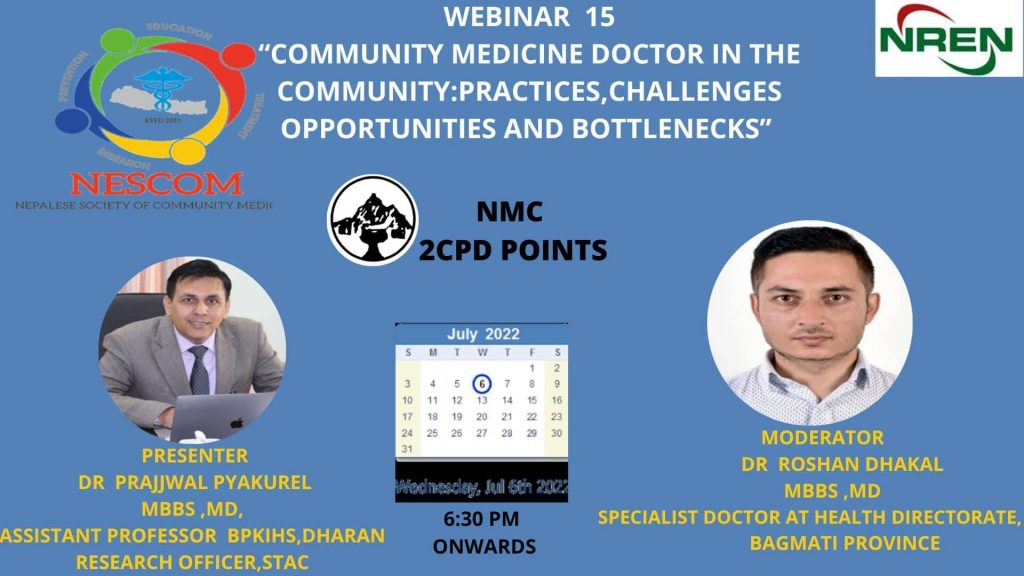
The Master of the ceremony, Dr. Bishal Sharma initiated the webinar with the introduction of the speaker Dr. Prajjwal Pyakurel and the moderator Dr. Roshan Dhakal.Dr. Prajjwal is an Assistant Professor at School of Public Health and Community Medicine, B. P. Koirala Institute of Health Sciences (BPKIHS), Dharan, Nepal and is currently writing a book called “Atlas of Tobacco in Nepal”. He is also working as a Research Officer in SAARC Tuberculosis and HIV center, Thimi Bhaktapur Nepal. He obtained his MBBS and MD in Community Medicine and Tropical Diseases from B.P. Koirala Institute of Health Sciences (BPKIHS), Dharan, Nepal. He is the visiting Lown Scholar for the Cardiovascular Health Program at Harvard T.H.CHAN School of Public Health, Boston, MA, USA. He is also the Co-investigator for a project on “Translational Research Capacity Building Initiative to address Cardiovascular Disease in Nepal” funded by the National, Heart, Lung and Blood Institute, USA. He is a senior facilitator for the Structured Operational Research and Training Initiative (SORT IT) led by the TDR, the UNICEF/UNDP/World Bank/WHO special program for Research and training in Tropical Diseases. He has more than 30 publications in various national and international journals. His research interest includes cardiovascular diseases, COVID-19, TB, HIV, and the Health system. Dr. Roshan Dhakal obtained his MBBS degree from Xuzhou Medical College, China. He completed his MD in Community Medicine and Tropical Diseases from BPKIHS Dharan, Nepal. He is currently working as a Health Specialist Doctor at Health Directorate, Bagmati Province, Nepal. He has actively participated and conducted various health promotion programs and health camps, health education, and promotion activities at the community level.
Dr. Dhakal pointed out the unique nature of Community Medicine associating its clinical practice with the community health perspective at the beginning of his session. He mentioned delivering comprehensive health care to the community with different levels of involvement in clinical care as one of the major responsibilities of a community physician. He also focused on the role of the community physician in coordinating with other services/specialties as a manager to implement prevention programs, perform community health needs assessments, and in advocating for health-promoting policies. The speaker of the session, Dr. Prajjwal, began with defining Community Medicine and its scope emphasizing the need by countries to formulate their own definition of Community Medicine in light of its traditions, geography, and resources as the final goal to meet the definition of health. He then cited examples from Christian Medical College, Vellore, All India Institute of Medical Sciences (AIIMS), New Delhi and BPKIHS, Dharan to list different scopes and fields of health services, ranging from teaching-learning activities to providing primary health care and coordination, communication and referral. In the end he discussed various national and international opportunities for a community physician with their associated challenges.
The presentation was wrapped up with thanking note from the Master of Ceremony of the Program. The webinar lasted for about 1 and half hours with about 70 participants and ended with the announcement of an upcoming webinar on “Health Perspective of Western Nepal: Before and after a decade”.
Objective:
- To understand the historical development of Community Medicine as a branch in the field of preventive and social medicine
- To compare and contrast between Community Medicine, Family Medicine, Emergency Medicine and Public Health with relevant examples from Nepal and India
- To discuss and distinguish the future direction of the Community Medicine fraternity; Community based clinician and Public health specialist.
- To discuss the importance, opportunities, challenges, and bottle-necks to the success of Community Medicine.
Key points that came out during the discussion:
- Community medicine is the specialty that deals with the population comprising of doctors who try to measure the needs of both sick and well people, plan and administer services to meet those needs, and engage in research and teaching in the field.
- Every country needs to formulate its own definition of Community Medicine in light of its traditions, geography, and resources.
- The Community Health Department in different medical colleges has developed different scopes and fields of health services, ranging from teaching-learning activities to providing primary health care to rural, urban, and tribal communities. The department provides training ground for medical, nursing, and paramedical students.
- Services provided in Christian Medical College, Vellore
- Care centers for the elderly
- Basic medical services
- Occupational Therapy
- Health Education
- Nutritional Support and Counselling
- Reproductive Health
- Family Life Education in the adolescent health program
- Services provided in All India Institute of Medical Sciences (AIIMS)
- Urban Health Center
- General OPD Services
- Free Medicine
- ANC Services
- Immunization Services
- Referral Services
- Lab Services
- Health Talks/Exhibition
- Street Play
- Rural Health Center
- Outpatient services
- In-patient services
- Emergency services
- Surgical services
- Laboratory services
- Radiological services
- Blood storage services
- Telemedicine services
- Pantry services
- Medical social services
- Counselling center
- Ambulance services
- Urban Health Center
- Services provided previously from BPKIHS Dharan, Comprehensive Health Service Area (COHSA)
- Doctors Run Clinic
- School Health Programme
- Guiding the students of Netherland and Switzerland as part of their community field activities
- Epidemiological Skills and Management (EPIDMAN)
- Training programme of District Health Office
- Training and Evaluation of undergraduate and Postgraduate students of BPKIHS
- Occupational Health Programme
- At present Kathmandu University and BPKIHS has specialization in Community Medicine and Tribhuvan University is on the way of the establishment of community medicine department.
- Curriculum of BPKIHS
- Physician for Tropical Disease at all level of Health Care
- Researcher and Epidemiologist
- Health Planner, Organizer, Administrator and Manager
- Teacher and Trainer
- Curriculum of Kathmandu University
- Community Physician
- Public Health Planner
- Health Manager
- Administrator
- Researcher
- Epidemiologist
- Teacher/Trainer
- Curriculum of BPKIHS
- Oppourtinities
- Role as a Community Physician in Primary Health Care
- Teaching learning and research opportunities in academic universities
- Challenges
- Goals: Lack of proper idea about goals of the subject/field in initial days of a career as Community Physician
- Leadership: Community Physicians working under public health experts rather than taking the leadership by own
- Human Resources (Trainee vs Students vs Staffs) with different interests
- Administrative Barrier (Ownership of a project, Power, Money (“2Ps”), Legality, Polices ):
- Managerial Challenges : Role and nature of leadership
- Support system: Mentorship, training
- Competing priorities: Family life vs professional growth
- Ethics and Morale
- Human Psychology ( Jealousy, Humiliation, Torture, Suppression, Victimization, Indirect way of saying)
- Institutionalization
- National vs International
- Services provided in Christian Medical College, Vellore
Points for the policy brief:
Currently there is no assigned position in the Public Service Commission, Government of Nepal, for Community Physicians. Government hospitals doesn’t have Community Medicine department. Advocacy is needed at different levels to develop policies to establish such positions in the government sector in order to enhance the opportunities and deliver services to the needy ones at the Community Level inside Nepal by the Community Physicians.
Points to be discussed in the executive committee:
- Advocacy by Nepalese Society of Community Medicine (NESCOM) to discuss the importance of Community Medicine doctors in Public Service Commission to create a post relevant to the subject.
- To explore the possibilities for job opportunities in national and international organizations for Community Medicine Doctors.
Conclusion:
Community physicians in Nepal are mainly limited in Medical Colleges and Academies being involved in teaching, learning and research activities. There is limited opportunities in government service. Advocacy to setup more job opportunities as a Community Physician in government sector is needed at the moment.