
Summary:
Sexual and reproductive health is an essential component of health and one of the pillars of Sustainable Development Goals (SDGs). Nepal is predominantly a country with young population with large proportion of population below age 30. The proportion of adolescents in Nepal is higher than the proportion globally. Despite Nepal being the first country in Southeast Asia that focused on adolescent health and development, still there are many hurdles that affect adolescent sexual and reproductive health. Among them, child marriage, menstrual hygiene management, menstrual taboo, gender-based violence, cyber bullying and exploitation remain the most important areas that urgent need attention and major improvements.
Brief Background:
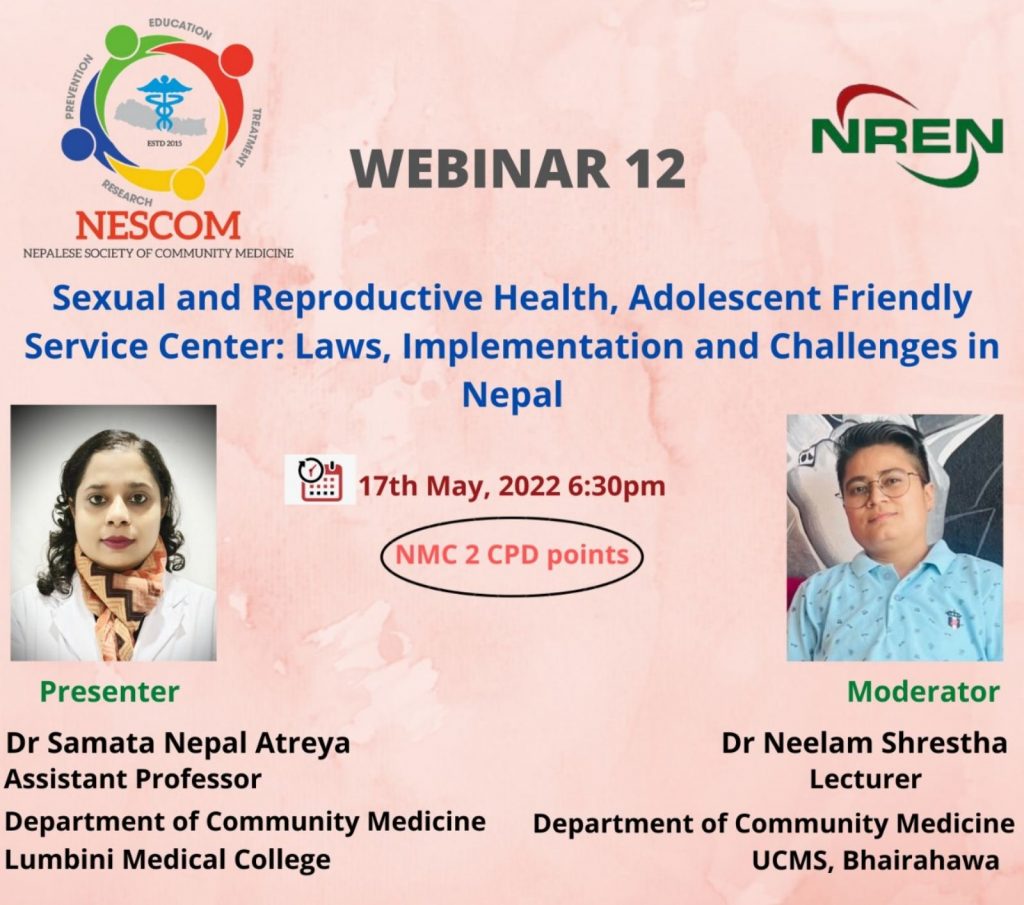
The master of ceremony – Dr. Sujil Manandhar started the proceedings of the webinar by introducing the speaker, Dr. Samata Nepal Atreya and the moderator, Dr. Neelam Shrestha.
Dr. Atreya works as an Assistant Professor at Department of Community Medicine, Lumbini Medical College, Kathmandu University. She is also a member secretary of Institutional Review Committee of LMC and also a research supervisor for medical students. She is a peer reviewer in different journals and her areas of interests are adolescent health, women health and NCDs.
Dr. Shrestha who was the moderator of the program, currently works as a Lecturer at Department of Community Medicine, Universal College of Medical Sciences, Bhairahawa. She is also a research supervisor for students of Bachelor in Public health.
Dr. Atreya started the presentation with justification of the topic: Sexual and Reproductive Health, Adolescent Friendly Service Center: Laws, Implementation and Challenges in Nepal, which she began with a brief definition of the adolescence phase and the changes that occur during this phase. She then explained about the different milestones that Nepal has achieved in terms of adolescent sexual and reproductive health with the latest revised strategy plan implemented on 2075 BS. She then described about the burden of different problems like child marriage, violence, menstrual taboos, cyber bullying in Nepal. The webinar also highlighted about the possible challenges at different levels we have to face in-order to improve the adolescent sexual and reproductive health in Nepal. Finally, Dr. Atreya talked about the areas that can be improved and policies that can be made to bring a positive change in the scenario of adolescent health in Nepal.
The completion of the presentation was followed by ice-breaking Zoom poll session focusing on understanding of the topic and about the Nepalese Society of Community Medicine (NESCOM).
Some interesting questions were raised after the poll questions which the speaker answered with excellent clarity and precision. The webinar lasted for 1.25 hour with over 90 participants.
The webinar ended with the concluding remarks by Dr. Sujil Manandhar (MC for the program) along with the announcement of the upcoming NESCOM webinar on “Economic evaluation in healthcare: Opportunities and challenges” on 1st June, 2022.
Objectives of the Webinar:
- To understand the global and regional burden of adolescent sexual and reproductive health related problems.
- To understand the current scenario of adolescent sexual and reproductive health in Nepal.
- To update on the strategies being conducted to improve adolescent health.
- To update on different policies needed to improve adolescent health.
Key Points Discussed:
- According to WHO, adolescence is defined as age between 10-19 years which is further subdivided into early adolescence (10-13 years), middle adolescence (14-17 years), and late adolescence (18-19 years).
- Adolescence phase is very vulnerable as it is a transition phase between childhood and adulthood where there are physical and cognitive changes, progression from puberty to sexual and reproductive maturity, development of adult mental process and change from socio economic dependence to somewhat independence.
- Adolescents constitute about 24% of population in Nepal which is higher than total global proportion.
- Adolescents are curious in nature and are new to domains of sexual and reproductive life. Nepal is one of the first country in South Asia to endorse the first National Adolescent Health and Development.
- Milestones:
- 1996 – Nepal was involved in Regional Strategy for Adolescent Health and Development.
- 1998 – Adolescent Sexual and Reproductive Health (ASRH) was included in Nepal’s National Reproductive Health Strategy.
- 2000 – Nepal developed its own ‘National Adolescent Health and Development Strategy’.
- 2007 – Implementation Guidelines developed.
- 2010 – National Adolescent Sexual and Reproductive Health Program was developed, as well as National Adolescent Friendly Health Services (AFHS) standards and action developed
- 2015 – NHSP II implementation plan had target to introduce 1000 AFHS in public health system (25% of govt. health facilities would be covered).
- Currently, revised “National adolescent health and development strategy 2075” has been implemented with the goal to promote the sexual and reproductive health status of adolescents and to provide information on adolescent health and development, increase utilization of adolescent health and counselling services, create safe and supportive environment, improve their legal, social and economic status, and to create awareness through BCC campaigns and at national, districts and community level.
- For the implementation of the strategy, key stages of the priority action were:
- Establishment of adolescent friendly services
- Development of Adolescent, sexual and reproductive health services which includes ASRH counselling services, Abortion services, Family planning services, GBV, Obstetrics services, General health services, Treatment of reproduction tract infection, STI including HIV, IEC.
- Increase ASRH service utilization by adolescent and lower ASRH morbidities and reduced adolescent fertility rate.
- Scale-up Adolescent Friendly Service (AFS) with up to 1331 health facilities in 73 out of 77 districts (except Khotang, Chitwan, Tanahun, Nawalpur) was done and certification of Adolescent Friendly Service sites of 104 health facilities was also done.
- Demand generation intervention program with one nurse in each school and establishment of Adolescent Friendly Information corner (AFIC) in school with sensitization of school teachers, students and peer educator on ASRH, AFIC done.
- Nepal is ranked third in the highest rate of child marriage with median age of marriage for female – 17.9 years. 52% of women and 19% male are married before 18 years. 30% of women are already mothers and 35.5% have begun child bearing during teenage with only 15% of currently married adolescents using a modern method of contraception. The unmet need of FP in 10-19 years is 35% causing AFR to increase from 81 in 2011 to 88 in 2016 per 1000 women of 15-19 years.
- Gender based violence is also major challenge as 9.6% of adolescents experienced violence during pregnancy whereas around 23.1% adolescent females have experienced some sort of physical, sexual, or emotional violence and only 69.1% of them never sought help or told anyone about violence. However, not only females, but around 11.95% of adolescent males are also victim of sexual violence which is very much comparable to females.
- Menstrual hygiene management is also another big hurdle in the improvement of sexual and reproductive health of adolescents. One fourth of the girls miss school during menstruation. Inadequate water and sanitation facilities at school, limited access to effective, hygienic materials for menstrual management, and inaccurate information about menstruation and the biology of puberty can be the reason for poor menstrual hygiene.
- Menstrual exile – “chauupadi” is still practiced in most rural parts of Nepal. It is a violation to a basic human right. Some form of menstrual taboo is present in both rural as well as urban areas of Nepal.
- Cyber bullying and sexual exploitation are a rising problem. 20% of adolescents have faced unintentional online sexual abuse whereas 14.12% (among total 340) have dropped out of school according to a survey. To address this issue, Cyber safety training should be conducted along with limitation of personal information on social sites, and research and awareness activities.
- Target 3.7 of SDG focuses on improvement of adolescent sexual and reproductive health but there are different policy level challenges like less-prioritized programs, unable to integrate into HMIS, lack of resources, lack of training, poor implementation, operational barriers, timings of AFS centers, and different health facility level challenges such as lack of infrastructure, lack of trained workforce, poor ownership of program at local level and other personal level challenges which might make it difficult for the Nepal Government to achieve this target.
Points for the Policy Brief:
- To improve Adolescent sexual and reproductive health, Adolescent friendly services in terms of accessibility, affordability, acceptability and disability should be provided with special training to communicate with adolescents.
- Government of Nepal should prioritize and integrate the adolescent sexual and reproductive health services into Health Management Information System (HMIS).
- Collaboration of health facility with schools for Comprehensive Sexual Education and mobilization of adolescents as trained volunteer should be done. Tele-health services focusing on population subgroups (rural, hard-to-reach, slums, street adolescents, out of school, minority/ disadvantaged, Muslims/Dalits, and displaced from emergency/disaster, trafficking) must be conducted with adequate supply of IEC/BCC materials.
Points to be Discussed in Executive Committee:
- Role of Nepalese Society of Community Medicine (NESCOM) for capacity building of Community Medicine residents and graduates for intensified research and innovation focused on Adolescent sexual and reproductive health with experts in the field.
- Building partnership and cooperation with Government of Nepal and other sectors in implementing programs necessary to improve Adolescent sexual and reproductive health.
Conclusion:
Adolescent health is a smart investment: a key to unlocking the lifelong health, productivity and national prosperity. Hence, it is of utmost importance that the government and private health sectors act together with proper inter-sectoral coordination to improve adolescent health.