
Summary:
Clinical trials are a type of experimental/ interventional research study that is proposed to compare new drugs/medicine, vaccine, treatment, procedure or intervention against an existing standard of care. It also examines and evaluates safety and efficacy of different therapies in human subjects by measuring the effectiveness and efficiency for the prevention, control and treatment of disease and improve the health of the community. Ethics are fundamental in any clinical trials and thus informed consent must be obtained from all the participants (cases and control).Historically speaking clinical trial was first reported in 1747 to identify treatment for scurvy. Slowly it has started to built up in Nepal and are getting successful.
Brief Background:
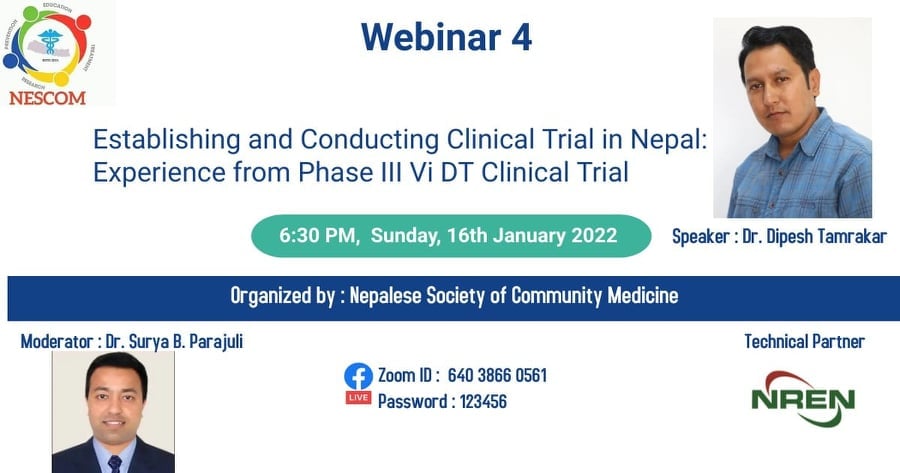
The proceeding of the webinar was started with the introduction of the Master of Ceremony, Dr. Pallavi Koirala. Dr. Pallavi Koirala introduced the speaker of the day who was Dr. Dipesh Tamrakar. Dr. Tamrakar is an Assistant Professor in the Department of Community Medicine, Kathmandu University School of Medical Sciences (KUSMS). He has been working in KUSMUS since > 5 years. He has been an active researcher in KUSMS. He was the principal investigator leading a phase III clinical trial of adjuvant recombinant SARS-COV-2 Protein subunit vaccine and oral cholera vaccine. The webinar was moderated by Dr. Surya B. Parajuli. who is an Assistant Professor of Community Medicine at Birat Medical College and has been actively involved in preventive, research and advocacy activities in eastern Nepal.
The webinar started off with a brief overview of clinical trials. Dr. Tamrakar mentioned about the various development phases of drugs/medicines in a clinical trial along with various types of clinical trials. He shared his experience of conducting the ViDT clinical trial and the challenges faced during its conduction. The completion of the presentation was followed by many interesting questions raised by the participants, making it an immensely interactive session. A zoom poll with 5 questions was also put forward in between discussions. The webinar lasted for nearly about one and half hours with 46 participants and ended with the announcement of an upcoming webinar on “Covid -19 Pandemic (Omicron variant), its transmission, dynamics, challenges for prevention and lessons learnt: Looking through government Lenses.”
Objectives of the webinar:
1. To learn about the process of conducting a clinical trial in Nepal, challenges faced and mechanism of overcoming it
2. To sensitize the Community Medicine Physicians for the initiation of clinical trial
Key points that came out during the discussion:
1. For the drug /medicine to go to the general population it has to go through various development phases. The phases start with the preclinical phase where it is tested on animals, then it has to go through Phase I, II, III and phase IV trial (post-marketing surveillance). The clinical trials don’t always have to start from Phase I, Phase 2, Phase 3. However, combination designs can also be adopted from the previous studies trials
The clinical trials design is of different types:
a) Trials to show superiority: Designed to show superiority over placebo or active control
b) Trials to show equivalence or non-inferiority: Experimental treatment/vaccine/device is compared with existing treatment without intent to show superiority
c) Bioequivalence trials: Response to two treatments differ by amount which is not important clinically
d) Non –inferiority trials: Experimental treatments with active marketed treatment
Nepal has contributed for about 200 (9.5%) superiority trials of total 2100 in the world
2.He also mentioned about various other trials going on in Nepal, such as “A parallel-group”, Phase III, Multistage, modified double-blind, multi-armed study to assess the efficacy, safety, and immunogenicity of two SARS-CoV-2 Adjuvanted Recombinant Protein Vaccines (monovalent and bivalent) for prevention against COVID-19 in adults 18 years of age and older
It is currently being done on in Dhulikhel Hospital, KUSMS, Nepalgunj Medical College and Institute of Medicine (IOM)
3. Another clinical trial titled “A phase III, Multicenter, Observer-Blinded, Randomized, Active Controlled Trial to Evaluate Immune Non-Inferiority, Safety and Lot-to-Lot Consistency of oral cholera vaccine- simplified compared to Shanchol in 1 to 40 years old Healthy Nepalese Participants” is going on in Dhulikhel Hospital, KUSMS, Nepalgunj Medical College IOM, and B.P.Koirala Institute of Health Sciences
4. He highlighted about certain steps that have to be followed in conducting a clinical trial, starting with a protocol formation, meeting criteria set by different organization and sponsor requirement and regulatory body
5. Ethics is the center of clinical trials. Thus, ethical consideration from the institutional IRB and the local IRB, patient recruitment and participant consent is paramount. On the parallel side data entry and review, quality check, statistical analysis, presentation and publication of report are done at the end
6. Certain criteria’s have to be fulfilled for evaluation of the site selection, some of which are geographical feasibility, access to well defined population/community, available infrastructure and qualified staff/human resources, regulatory requirements (NRA/Site IRBs) and prior experience(s) with clinical trials/surveillance studies
7. Evaluation of criteria for site selection site must be of interest, support from institution’s higher authorities/leadership/management, available infrastructure, availability of qualified staff / human resources
8. Since the trial was non-licensed various regulatory bodies like WHO PQ, KMFDS, NHRC and DDF’s consultation was done for the ViDT clinical Trial.
9. The team of the trial consisted of co-investigator, clinical research coordinator, pharmacist field worker, field supervisor, field worker, microbiologist, senior advisor, nurse, data operator/phlebotomist, volunteers etc. with principal investigator leading the project
The following things were assured:
1. Preparation of human resource training was done as central training, site specific training, mock drills/dry run and hands on training
2. Proper logistic management including areas separate for pre-screening, consent, physical examination, randomization was properly organized
3. Stakeholder engagement and management, internal faculty meeting, media focal person meeting was conducted in order to clear out doubts and rumors
4. Participant recruitment plan, immunization clinic (vaccination records, follow-up, OPD visit logs, defined catchment area, demographic data etc. was properly managed to maintain the quality compliance
5. The participants were given a diary for record of solicited side effects up to 7 days and unsolicited up to 21 days, serious adverse effects throughout the study period for 6 months
Point for policy brief:
Clinical trial is in the evolving phase in Nepal. Ministry of Health and Population, Government of Nepal along with its various health bodies should create an enabling environment to conduct clinical trial in Nepal. Strong clinical and public health background of Community Medicine graduates should be utilized for smooth operation of clinical trial
Points to be discussed in the executive committee:
1.Role of Nepalese Society of Community Medicine (NESCOM) for capacity building trainings and conduction of clinical trial of community medicine graduates
2.Applying for a grant and develop team work among the NESCOM members to conduct clinical trial in Nepal
Conclusion:
Clinical trials are crucial to gain knowledge and experience which acts as a guide for further research. There are many hurdles in setting clinical trials in Nepal but experiences from trials like “Phase III ViDT typhoid conjugate vaccine trial” can teach and encourage to conduct many more such trials in the coming future.