
Summary:
Whole genome sequencing (WGS) is a comprehensive method of analyzing the entire DNA sequence of an organism’s genes. It is a laboratory process that is used to determine nearly all of the approximately 3 billion nucleotides of an individual’s complete DNA sequence, including non-coding sequence. In Nepal, the National Public health laboratory has started performing whole genome sequencing tests in its own laboratory from the government sector for tracking properties of the virus. This technology was set up with financial assistance from the World Health Organization.
Brief Background:
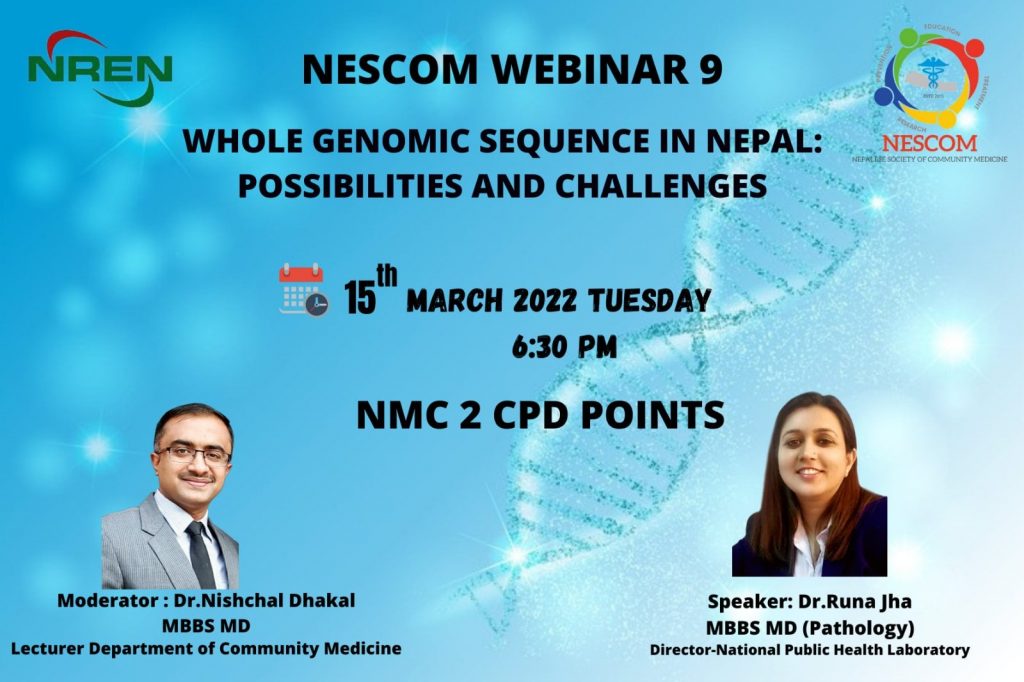
The Master of ceremony, Dr. Swikriti Koirala initiated the webinar with the introduction of the speaker Dr. Runa Jha and the moderator Dr. Nishchal Dhakal. Dr. Jha is the Director of the National Public Health Laboratory and current President of Association of Clinical Pathologists of Nepal. She received her postgraduate degree in Pathology from Institute of Medicine, Tribhuwan University. She also has worked as Faculty in Department of Pathology at Institute of medicine for 10 long years and got promoted to Associate Professor and then moved to Government Service as Chief consultant Pathologist. Her contribution in the field of laboratory works during this ongoing COVID-19 pandemic is unforgettable, for which she was selected by UN women to feature as “one of the five women on the front lines of COVID-19, COVID response” in April, 2020. She was appointed as an Ambassador for Peace by Universal Peace Federation in March, 2021. She was also selected by WHO SEARO to share video space with women leaders in Health in South East Asia on occasion of International Women’s Day 2021. Dr. Dhakal is currently working as a lecturer in the Department of Community Medicine in Nepal Medical College. He has worked as trainer for WHO/EDCD for contact tracing and case investigation and also was a part of the contact tracing team during the very early stage of COVID-19 pandemic. He is WHO/EDCD trainer for Epidemic and Pandemic Preparedness and Response training program.
The session started with the introduction of the topic, Whole Genome Sequencing in Nepal: Possibilities and Challenges, by Dr. Jha. She then gave a brief history of sequencing along with some interesting facts. She enlightened the diverse applications of WGS in clinical medicine and their different types. She further discussed about sequencing process and their challenges in context of Nepal. She then shed some light upon the conceptualization, establishment and functioning of Genetic Consortium in Nepal. Last but not the least, she talked about issues and challenges they faced and possible solutions and future plans regarding strengthening genetic research.
The presentation was wrapped up with few questions raised by the participants.Five questions zoom poll was put forward in regard to the presentation and understanding the society. The webinar lasted for about 2 hours with 100 participants and ended with the announcement of an upcoming webinar on “Evolution of Tobacco Epidemic in Nepal: Where are we heading?
Objectives of Webinar:
- To understand molecular and bio-informatics principle for sequencing
- To understand commonly used technologies for sequencing
- To understand commonly used data formats and bio-informatics methods for analysis of sequence data
Key points that came out during the discussion:
1. Whole genome sequencing can be used in
a. Molecular characterization
b. Pharmacogenomics
c. Population screening for disease risk
d. Prenatal screening
e. Individualization of treatment
2. There are first generation, second generation and third generation sequencing. First-generation methods enabled sequencing of clonal DNA populations. The second-generation massively increased throughput by parallelizing many reactions. Third-generation methods allow direct sequencing of single DNA molecules.
3. The facility established in National Public Health Laboratory is a Nanopore DNA sequencing machine which is small and cost effective.
4. Nepal sent the samples in early days of pandemic for genetic sequencing from WHO Nepal through coordination with WHO Regional Office for South-east Asia and headquarters facilitated to provide genetic sequencing service through the WHO laboratory at School of Public Health, Hong Kong, Special Administrative Region of China, under the global Influenza Surveillance and response system (GISRS).
5. To further increase the number of genomes sequenced and reduce the turnaround time, WHO also facilitated a collaboration between National Public Health Laboratory (NPHL) and the New Delhi-based Institute of Genomics and Integrated Biology (IGIB) resulting in the country sequencing around 50 genomes per month.
6. A second collaboration between NPHL and the New Variant Assessment Platform (NVAP) at UK health Security Agency (previously known as Public Health England UK) has now enabled the country to sequence around 150 genomes per month.
7. The National Genetic Consortium was conceptualized on February 17, 2021. Three committees were formed by MOHP: National Genetic Consortium, Technical Working group and steering committee.
8. Setting up of this consortium is a step in the right direction towards enhancing surveillance and detection in the country and ultimately contribute to strengthening the health system towards being better prepared to respond to emergencies and outbreaks of any type.
9. The facility will enable the country to do genomic surveillance of other pathogens including Influenza Virus; antimicrobial drug-resistant bacteria; Mycobacterium tuberculosis; Plasmodium species (Malaria parasite); and zoonotic, high threat, and emerging pathogens. Further, it will help the country to rapidly identify and/or confirm high threat pathogens of public health concerns including hither to unknown pathogens.
10. The consortium enabled Nepal to detect and confirm the latest SARS-CoV-2 variant of concern, Omicron, in the country with an impressive turnaround time of five days.
11. The biotechnology department of Tribhuvan University, the Dhulikhel Hospital, Epidemiology and Disease Control Division, Central Veterinary Laboratory, Nepal Academy of Science and Technology (NAST), Walter Reed/AFRIMS Research Unit Nepal (WARUN) and WHO Country Office for Nepal are the members of the consortium.
12. Several Ethical and practical challenges and dilemmas were identified associated with WGS including
i. Revelation of “off-target” mutations
ii. Many revealed disorders will have no prevention or treatment
iii. Revelation of nonpaternity, consanguinity, incest.
iv. Costs of genetic counseling and follow up
v. Possible forensic uses of data
vi. Data storage and privacy
vii. Huge number of novel missense variants
Points for the policy brief:
To develop Whole Genome Sequencing at advanced level there needs dedicated and trained human resources with establishment and strengthening of bioinformatics unit at NPHL. Collaboration and Coordination with different National and International Laboratories is paramount to strengthen the network. Extending sequencing for other pathogens is needed in the longer run.
Points to be discussed in Executive committee:
Role of Nepalese Society of Community Medicine (NESCOM) and Community Medicine Graduates in Genetic research
Conclusion:
WGS have the capacity to greatly enhance knowledge and understanding of the infectious disease and clinical microbiology. Given current resources and infrastructure limitations, WGS is most applicable to use in Public health laboratories, reference laboratories and hospital infection control laboratories. Although genomic technologies are rapidly evolving, widespread implementation in clinical and public health is limited by the need for standardized quality control and data interpretation, bio- informatics, expertise and infrastructure.