
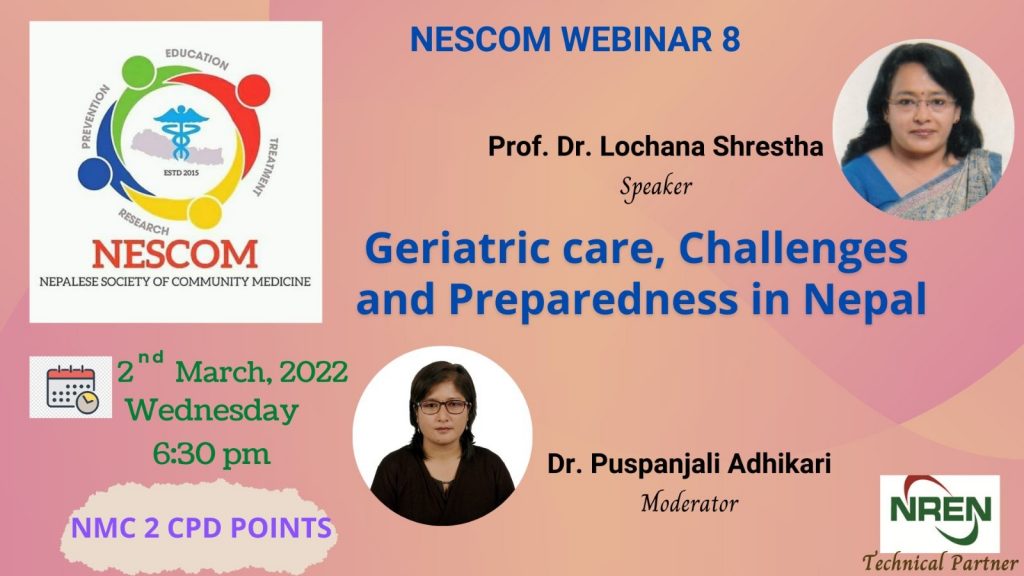
Summary:
The World Health Organization (WHO) finds healthy aging as the process of developing and maintaining the ability that enables wellbeing in older age. It is natural for everyone to expect to be happy and healthy in later parts of life. We all dream of an old age without dependence or inconvenience. Anyone living in any part of the world should have the opportunity to live a long and healthy life. Healthy aging is one of the WHO’s primary focuses between 2015-2030 as the decade between 2020-2030 has been dubbed as the “decade of healthy aging”. This webinar will help contribute to an enhanced understanding on prevailing challenges and preparedness for Geriatric care in Nepal.
Brief Background:
The proceedings of the webinar was started by Master of Ceremony, Dr. Alisha Manandhar. Dr. Alisha started with the introduction of the speaker Prof. Dr. Lochana Shrestha and the moderator Dr. Puspanjali Adhikari. Prof. Shrestha is currently the President of Nepalese Society of Community Medicine (NESCOM) and is leading the Community Medicine department at Nepalese Army Institute of Health Science (NAIHS). She is also an honorary member of the Council of UN International Institute of Aging. Her publications on International and National are related to Geriatric, Diabetes, Maternal and Child Health and HIV/AIDS. Dr. Puspanjali Adhikari, is the project lead of several international collaborative projects on non-communicable disease and is also an Executive Committee of Nepalese Society of Communication Medicine.
The webinar started with a brief introduction about the Healthy Geriatric Care and decade of healthy aging between 2020 to 2030 in the world and a brief about the challenges of healthy aging in context to Nepal. She highlighted on various data about Geriatric aged people over the period of time around the globe and of Nepal. Prof. Lochana briefed about geriatric care provided in different places by different levels of care givers, depending on persons need. Though it has been a hidden issue in community level, the speaker had given emphasis on the linkage between burden of NCDs and growing old age population. Additionally, she talked about the various EDP Key activities, quality health care for elderly and the outcomes of specific focused geriatric care. Most importantly, the speaker focused on issues and challenges that needs to be addressed at the policy level. She further discussed the components of Geriatric care, facilities that are necessary for the care of elderly people followed by the challenges and policy implemented by the government for the care of elderly people. Prof. Shrestha emphasized on the challenges about the elderly people care policy adopted as well as some suggestions for the policy makers regarding the care of elderly people. She had also put forwarded some of the long-term services and also had talked about the importance of recreational services, spiritual services and their outcomes on old age population.
The completion of the presentation was followed by many interesting questions raised by the participants making it an immensely interactive session. Five questions zoom poll was put forward in discussions. The webinar lasted for nearly about 2 hours with 95 participants and ended with the announcement of an upcoming webinar on “Whole Genomic Sequencing in Nepal: Possibilities and Challenges.”
Objective:
- To provide information about Healthy Geriatric Care in Nepal
- To highlight on prevailing challenges and awareness in Geriatric Care in Nepal
Points for Policy brief:
- The Government of Nepal has provided a limited allowance for the elderly people, the amount provided is not sufficient for them. The Government of Nepal should increase the allowance for elderly people. They should also increase the expenditure in health and benefit for the elderly by focusing mainly in the development of human resource i.e., trained personnel, proper facilities and equipment.
- Data system of the elderly people should be accurate. Data related to elderly diseases should be collected from both public hospitals and private hospitals, local bodies and the Ministry of Health and Populations.
Points to be discussed in executive committee
- Reason for long term care service not being open towards geriatric care and service related to geriatric service.
- Policy suggestions for the government to mitigate the absence of legal structural framework, policy, plan and process to support geriatric care.
Key points that came out during the discussion:
1. There were 8.6% of geriatric population which is bound to increase in coming days
2. Geriatric population is facing various problems that include physical problems, psycho-social problems which needs urgent attention
3. Geriatric Care is important as it allows senior patients to receive specialized care that understands their needs. Nowadays, the priority has been shifting to geriatric groups
4. Leading cause of deaths among the elderly people is due to non-communicable disease
5. Increase in the proportion of elderly population may cause risks such as:
a. Structural changes
b. Conflict: Where elderly people think that they are left out from society.
c. Modernization: Difficult in adopting or adjusting with the system due to change in technology and methodology over the period of time.
6. Geriatric care should be specific, effective, and passionate and age friendly with love and affection.
7. Components of geriatric care includes:
a. The presentation of diseases or problems is frequently complex
b. Common diseases present atypically in this age group
c. Comorbid diseases may confound the presentation
d. Poly-pharmacy is common and may be a factor in the presentation, diagnosis and management since geriatric group is taking so many drugs at once
e. About 30% to 40% of elderly patients have cognitive impairment so recognition of possible cognitive impairment is very important
f. Some diagnostic tests may have different normal values
g. The likelihood of decreased functional reserve must be anticipated. For example, the immune system may become sluggish in response to infection
h. The patients might have to rely on caregivers because social support systems may not be adequate to the patient at that period of time.
i. Before providing the service for elderly people, a knowledge of baseline functional status should be kept in mind. The information that is obtained from the family, patient, the caregiver, old records can be used to establish this baseline.
j. Check on signs of depression, anxiety, and alcohol abuse in geriatric population since these are very common in the elderly group. These problems must be evaluated for associated psychosocial adjustment
8. How is Geriatric Care different from Parent Care?
a. Geriatric Care: It is also known as Family Care where problems are shared with family members and training regarding the care is provided to the members of the family. Decision for the care taker takes a longer time will lead to nonproductive output. For Geriatric care mature and confident family members are needed so that they can plan about the care to the earliest possible
b. Parent Care: It is also known as pediatric care where only parents are endangered for the care of the children. There is immediate action for any problem which leads to productive output
9. Geriatric care benefits the physical, mental and social health of the elderly by benefiting the family members, community and nation as a whole
10. Geriatric Care varies from places like Home Based Care, Nursing Homes, and Residential Long-Term Care Facilities as per the service of the caregiver
11. For the health care of the elderly, proper health personnel with proper financial, equipment benefits should be provided. For the proper care of elderly people there should be mobility, personal care, medication and proper nutrition
12. Caring elderly people is a great challenge due to the unknown needs of the older people and also people’s perception towards elderly people, as the burden of society. There are many other challenges while looking after elderly people such as medical issues, safety of elderly people due to social environmental factors and lack of love from the family members.
13. In Nepal, there is no proper availability of data on elderly diseases, also there is no availability of geriatric professionals who can work for the betterment of elderly people.In addition, there is no monitoring system for the service provided by the health personnel. Although, Government of Nepal has provided financial support to the elderly, it is not adequate for their proper care.
14. In Nepal, the Ministry of Women, Children and Senior citizens works for the elderly people. There are many sections and departments that work for the elderly people. The Nursing and Social security section is among many sections that works for the betterment of the elderly population however they are limited. Similarly, Geriatric and Gender Violence management section looks mainly for the issue for the elderly people.
15. There are many policies formed by government for the care of elderly people:
a. Senior Citizen Policy, 2001
b. Madrid Plan on Action on Aging, 2002
c. The senior citizen Regulation, 2008
d. Public Health Service Act, 2018.
Conclusion
Importance of Geriatric care services is a very essential topic that needs to be addressed. Besides the usual curative services, people need to shift their focus on other aspect of geriatric services which should be sellable at the policy level. Country needs to increase its expenditure in health and focus on the development of skilled human resources. In this path of service, advocacy is crucial to penetrate the traditional bounded society for better care for this group of people making their remaining life comfortable. Furthermore, the state should also provide healthy, active, independent and contributory living prospects to senior citizens like preventive and curative health packages, quality elderly friendly service along with trained multi-disciplinary teams with private-public partnership. At the end we should always remember that “older people might be retired, but they are not tired.