
Summary:
The South Asian regions are mostly exposed to earthquakes, landslides, drought, and floods every year rather frequently, and with a comparatively poor economy, the vulnerabilities tend to be elevated. Prevention is the key. Only with proper training in regard to disaster preparedness and management we can decrease the disaster-associated burden in the region; considering the unanticipated nature of disasters. Man-made disasters may be attempted to be prevented, but natural disasters will continue to occur, hence we can only mitigate their effects, and for that capacity building in various dimensions is crucial.
Brief Background:
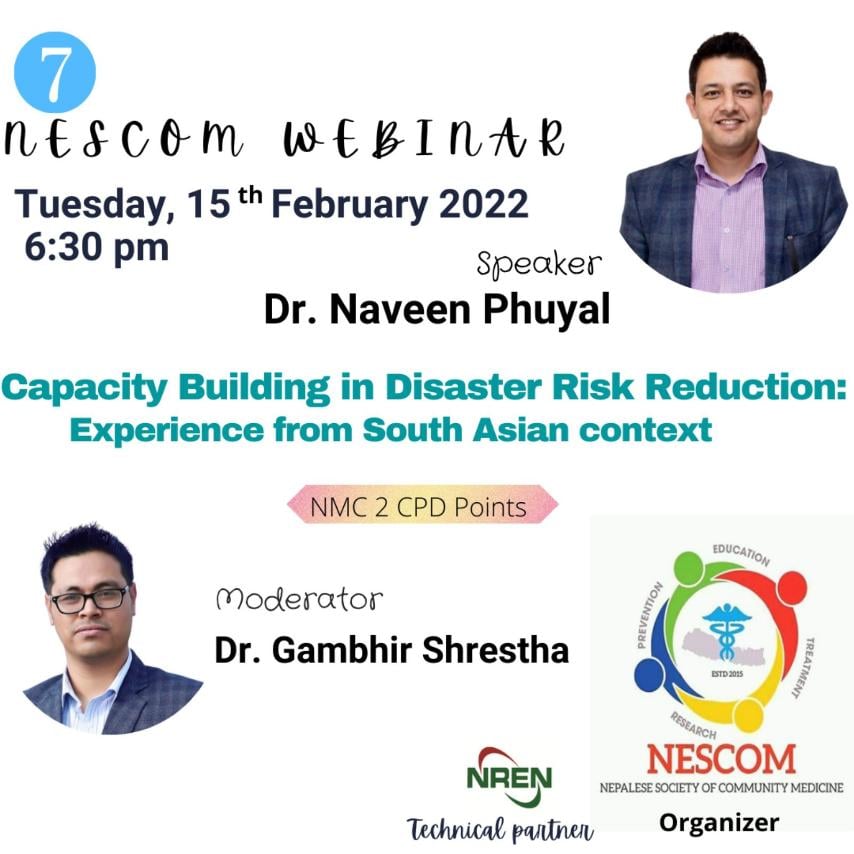
Dr. Alisha Manandhar, the Master of Ceremony for the webinar, started the program acknowledging the combined efforts of all the team members to make seminar series a success. Eliciting the vulnerabilities of the South Asian region to the various types of disasters, she then went on to highlight the need for capacity building, especially in South Asian Region. Thus, prefacing the topic, Dr. Alisha began introductions of the speaker of the session, Dr. Naveen Phuyal, and the moderator Dr. Gambhir Shrestha.
Dr. Phuyal, who is actively involved in assisting in various natural disasters in the Nation and the International platforms, was an apt person to guide us in understanding the importance of capacity building for mitigating disasters, and Dr. Shrestha, with his broad expertise in different areas of Public Health, was able to conduct the session very smoothly.
Quoting Prof. Eric Noji, “Disasters are defined by what they do to the people otherwise, they are simply an interesting geological or meteorological phenomenon.” Dr. Phuyal gave us the broad strokes of the current reality in a contest of disasters occurring in the South Asian regions and then launched the subject of disaster epidemiology. He has abundant hands-on experience in the field of disaster preparedness, therefore, Dr. Phuyal was able to paint a clear picture regarding the current need in regards to disaster management. He further listed the various ongoing capacity-building activities that are available and ongoing to counteract the upcoming disasters at the National level. Dr. Phyual had a few thought-provoking questions for his polls, which engaged the participants. With these questions, he highlighted the importance of epidemiology of disasters more. Lastly, a brief but fruitful discussion regarding how the rescue activities are coordinated securely ensued, and the matter was expertly addressed by Dr. Phuyal, which bought about the end of the session
Objectives of Webinar:
- To understand the disaster epidemiology in the context of the South Asian Region.
- To know about the various residential and nonresidential training programs available for capacity building for disaster risk reductions that are currently ongoing in Nepal.
Key points discussed:
Similar natural hazards may affect dissimilar populations differently as per their vulnerability and their level of preparedness.
- Though the average cost per natural disaster is less in the South East Asian countries, as compared to the developed countries, with the frequency of disasters and the vulnerabilities in this area, the accumulative yearly cost due to natural disasters will be much higher.
- Unplanned urbanization and population growth have led to increased human-induced disasters in the South Asian regions.
- Some of the capacity building activities ongoing in Nepal are:
a. Hospital Preparedness for Emergency (HOPE):-
Developed by USAID (U. S. Agency for International Development) / OFDA (Office of the US Foreign Disaster Assistance). It is 4 days residency programme in collaboration with experts from India, Indonesia, Nepal and Philippines. Target populations are Hospital managers, doctors, nurses, HCWs (Health Care Workers) from Sri Lanka, Nepal, India, Pakistan & Afghanistan. It helps to conduct regularly vulnerability assessment of hospital and develop a disaster response plan. In Nepal conducted it was conducted in province 3, 4 ,5 ,6 & 7. It is funding dependent project.
b. HOPE Training for Instructor Course (HOPE TFI):-
Here participants will be potential HOPE instructors from HOPE courses. It is a 5 days residential training conducted in Nepal and India.
c. Emergency Medical Response Team (EMRT):-
They are Nepal army medical corps under ESOMT (Epidemiological surveillance and outbreak management team), Disaster response and management core.
d. Emergency Medical Deployment Team (EMDT):-
Physical and virtual training conducted by HEOC (Health Emergency Operation Centre) and MoHP (Ministry of Health and Population) in satellite hospital network. Dr. Phuyal had made SOP (Standard Operating Procedure) of HEOC as a member of technical working group. Had organized trainings, drills, policy and planning for incident command system and disaster store management capacity building at different levels.
e. Mass Casualty Management (MCM) Review and Update Workshop:-
It reviews and update mass casualty plans under leadership of HEOC. Four days residential training is conducted where Directors, Disaster committees of Hub and Satellite hospitals are targeted. Initially it was started at Kathmandu and later changed to HDPR (Hospital Disaster Preparedness and Response) and extended to other provinces hub and satellite hospitals.
f. Outbreak management plan:-
It is 2 days non-residential training as an extension of HDPR. Screening triage, Epidemic triage, Epidemic emergency unit, Isolation, Donning and Doffing and Contingency are its major outputs.
g. Mass casualty exercise: –
It does natural and human induced outbreak drills and outbreak drills conducted in all provinces of Nepal. It was done in Kathmandu Medical College, Sinamangal and Patan Hospital, Lagankhel.
h. Disaster Management Awareness Programme (DMAP):-
Done with support from US Embassy and US Office of Defence Cooperation (USODC). Targeted to 3rd year and 4th year Medical and Nursing students to address their deficiency in Disaster knowledge in medical/nursing curriculum. It does orientation and (Basic Life Support) BLS trainings.
i. Disaster Response Expertise & Exchange (DREE):-
It is multinational exercise including indopacific, regional and country coordination. Largest disaster exercise in Nepal. It tests the frameworks and interoperability.
j. Disaster risk communication Subject Matter Expert Exchange (SMEE):-
It is one-week training on disaster risk communication organized by US PACOM (US Pacific Command) and CDC (Centre for Disease Control and Prevention. Targets are Nepal Army, Nepal Police, Armed Police Force officials from Ministry of Health and Population and Ministry of Home Affairs. Similar training is also given by WHO.
k. Force Health Protection: –
It is doctrine of Health protection in Armed forces. It is supported by US PACOM which deals with preventive, promotive, curative and rehabilitative care for Armed forces.
l. Global Outbreak Alert and Response Network Southeast Asia (GOARN):-
International and collaborative mechanism which engages the resources of technical agencies for rapid identification, confirmation, risk assessment and response to public health emergencies of international importance.
m. COVID 19 Crisis Management Coordination Centre (CCMC):-
It is an agency created to respond to COVID-19 pandemic of Nepal including treatment, management and health infrastructure expansion.
Creating public awareness and information management; formation and operation of quick response teams and emergency transportation; and rescue and arrangement of patient receiving team and corpse management are also operated by CCMC.
n. Procurement and Supply Management Project (PSM):-
It works on capacity building in supply chain management. Emergency outbreak response platform empowering supply chain professional.
Point for the policy brief:
a. Ministry of Health and Population, Government of Nepal should put the courses of disaster management, prevention in school and college syllabus. Government should advertise about it in radio, TV and newspaper. Capacity building effort for Community Medicine and Public Health graduates are required to mitigate disaster in the country.
b. Government should form technical, competent and responsible team for disaster management which focus on preventive, curative and rehabilitative services. Prevention medicine and public health experts should be utilized to the best of their potential.
Points to be discussed in executive committee:
a. Conducting epidemiological study on disaster by Community Medicine team
b. Capacity building effort of Community Medicine graduates in disaster risk management in terms of research, trainings, workshop, drills at different levels and increase its efficiency
c. Mechanism of coordination, collaboration with public, private and international agencies
Conclusion:
Countries in the South Asian region are in a rather vulnerable position, due to the repeated occurrence of natural disasters and should focus on strengthening their capacity to prepare for any unforeseen disasters. Capacity building activities includes individual training, organizational development, improving functioning of groups within organizations, having standard protocols of operations in place to be used when in need, regular training of personnel and allocation of essential resources. Capacity-building should be an ongoing process as it helps in future mitigation activities.