
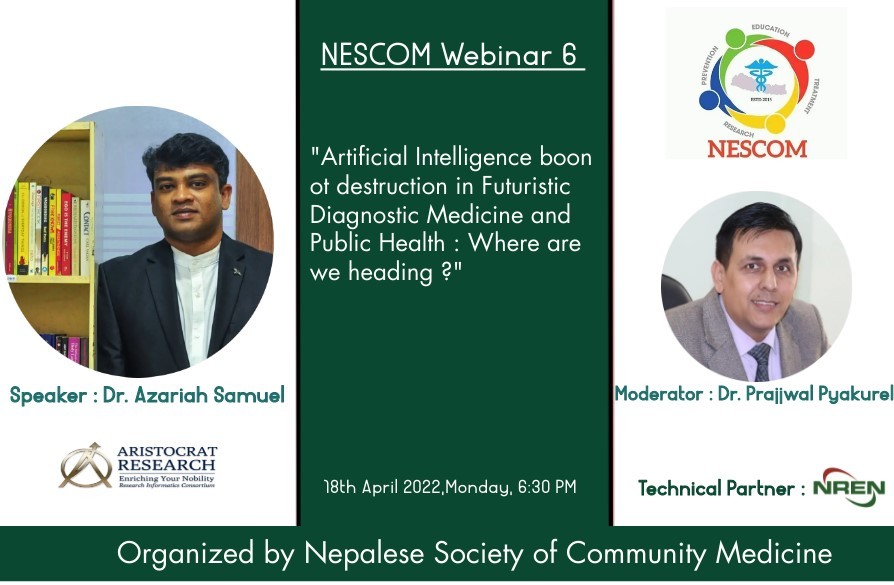
Summary:
Artificial intelligence (AI) refers to the simulation of human intelligence in machines that are programmed to think like humans and mimic their actions. Artificially intelligent computer systems are used extensively in medical sciences. Common applications include diagnosing patients, end-to-end drug discovery and development, improving communication between physician and patient, transcribing medical documents, such as prescriptions, and remotely treating patients. Recent advances in computational algorithms have achieved levels of accuracy that are at par with human experts in the medical sciences. A few years from now, certain roles in medical science may be completely filled by machines. Furthermore, unprecedented ethical concerns associated with its practice are being addressed, such as data privacy, automation, and representation biases. The purpose of this webinar is to discuss how AI is changing the landscape of medical research and to separate hype from reality.
Brief Background:
The webinar was started by the Master of Ceremony, Dr. Kapil Duwadi, who reminded the audience that this would be a repeat of webinar 6 which had to be rescheduled due to technical difficulties in the previous scheduled date. As the session began, Dr. Kapil introduced speaker of the session Dr. Arun Kumar Annamalai and the moderator of the session Dr Prajjwal Pyakurel.
Dr Arun Kumar is affiliated as non-academic member to the board of studies of the department of French and foreign languages at the university of Madras. He is a linguist with more than 10 years of experience in research in language acquisition and allied sciences. Dr. Arun Kumar is a medical doctor with multidisciplinary expertise in Family medicine, Public health and Epidemiology, Clinical Data Science: machine learning, deep learning, AI, medical devices and robotics operational research in health care, end-to-end knowledge of research and development including trials and regulatory affairs. He is specialist in managing, analyzing and interpreting unstructured clinical data, blockchain technology enthusiast, telepsychiatry and AI in mental health enthusiast. He is an expert in clinical validation of drugs, devices, diagnostic vaccines and informatics developing and deploying advanced clinical decision support systems. He is a published author and keystone speaker. He is a renowned reviewer in reputed Psychiatric journals namely Frontiers in Psychiatry and Indian journal of psychological medicine. Similarly, our moderator Dr. Prajjwal Pyakurel is affiliated with BP Koirala Institute of Health Science, Dharan.He is currently engaged in writing an Atlas on Tobacco use in Nepal. He is also working as a Research Officer in the SAARC Tuberculosis and HIV/AIDS Centre in Thimi, Bhaktapur. He is an executive member of NESCOM and leads the NESCOM webinar series.
The webinar started with brief introduction about AI and its infiltration in our health sector especially clinical practices, public health and epidemiology. Dr Arun Kumar highlighted about one of the burning questions that he gets in every session i.e. Will AI replace a doctor? To this query he answered it will not replace a doctor but it will bring significant changes in a way clinical practices, Public Health and Epidemiological practices are done. The speaker briefed us about importance of integration between Doctors, Engineers and Algorithm of patient’s data which are the key ingredients to develop an AI. He emphasized about the fact that, for a doctor trying to venture into domain of artificial intelligence one should only have basic knowledge about Mathematics, Statistics, Computers and Programming. You don’t have to be an expert programmer because we always have engineers to collaborate when it comes to advance technique required. He talked about the traits that an AI enthusiast doctors need to know and need not to know. These traits are described below. In this session speaker discusses and gives illustrated presentation on clinical data vs clinical data science, structured data vs unstructured data, clinical decision support system structure, types of CDSS.Speaker also reflected on ideas of building CDSS, fair data, technical validation of CDSS.In the final part of the session he discussed about questions that are to be asked while deploying AI in the field of Public health and Epidemiology. Finally, the session was wrapped up with interactive question and answer session with the participants and speaker. Webinar lasted approximately for an hour.
Objectives of the webinar:
1.To understand AI in health care -What should I know as a doctor and what I do not need to know
2.To understand use of AI in Public Health and Epidemiology by applying Clinical Data Science, Data Standards and Research Data Stewardships-fair principles
3.To have clarity regarding questions to be answered for deploying AI in Public health and Epidemiology
Key points that came out during the discussion:
1.Doctors trying to venture into domain of artificial intelligence don’t need a mastery over highly complex statistical and computational complex
2.Doctors trying to venture into domain of AI should be able to answer following questions:
- What is the purpose and the context of Algorithm?
- How good were the data used to train the algorithm?
- Were there sufficient data used to train the algorithm?
- How well does the algorithm perform?
- Is the algorithm transferrable to new clinical settings?
- Is the output of the algorithm clinically intelligible?
- How will this algorithm fit into and complement current workflows?
- Has use of algorithm been shown to improve patient care and outcomes?
- Could the algorithm cause patient harm?
- Does use of algorithm raise ethical, legal and social concerns?
3.A clinical decision support system (CDSS) is an application that analyzes data to help healthcare providers make decisions and improve patient care.
To build a CDSS we need,
- Team
- Data that includes fair principles and data principles
- Analytic use of n-of-1 approach
4.A doctor should be able to answer on following topics for deploying AI in Public health and Epidemiology
- Scientific directions
- Resource Sharing
- Maximization of research potential of existing cohorts
- Methods and technologies
- Training and work force development
- Integration of observational and interventional epidemiology
- Evaluation and return on investment
Points for the Policy Brief:
Role of AI is crucial in the current era of information and technology. It can revolutionize the way health care practices in Nepal. Hence, it is important that Ministry of Health and Population, Government of Nepal incorpates the role AI in different programmes and operational research activities so that that health system gets benefitted
Points to be Discussed in Executive Committee:
Digital Health is the burning field in the current era of information and technology. Mechanism of grooming young residents and graduates of Community Medicine in the field of Digital Health is paramount for the subject to be developed in coming years
Conclusion:
The ultimate aim of doctors working with an AI or clinical data science is to create a support system that will enhance our clinical decisions. Our main goal is to reduce no of errors in clinical decisions, public health settings and epidemiology. The only aim is to decrease false positives and false negatives as far as possible