
Summary:
COVID 19 is a wakeup call to the world, and has posed various challenges to the health care system, especially due to the continuing emergence of mutation of the virus, hence, it is imperative to build sustainable health emergency preparedness system. Likewise, Nepal has had to face its own share of challenges, which was managed efficiently by the government through leadership and multi-sectoral involvement through joint committees, public/private partnership, involvement of security forces, NGOs/INGOs all working together on a common platform. The need of recruiting experts especially in the field of Public Health and Community Medicine was recognized. However, there are still many challenges in terms of the new emerging variants of the SARS-Cov-2 virus, hence it is important to strengthening co-ordination across all three tiers of the government, increase surveillance for early detection and prompt action, human resource and international community support and private sector involvement
Brief Background:
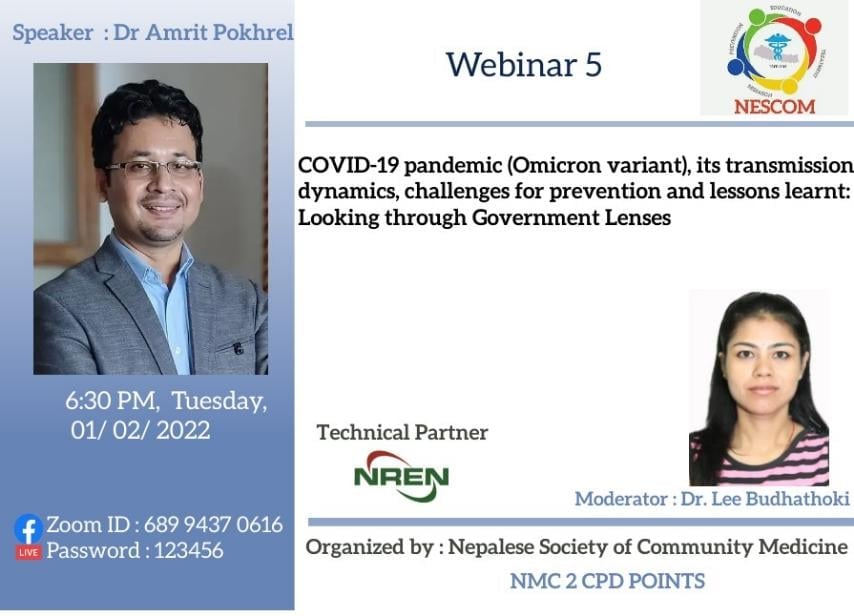
The proceedings of the webinar was started by the Master of Ceremony, Dr. Pallavi Koirala, who started with the introduction of the speaker Dr. Amrit Pokhrel. Dr. Pokhrel is the Section Chief of the Epidemic and Disease Outbreak section at Epidemiology and Disease Control Division (EDCD) under MoHP and is currently leading the COVID pandemic response including strategy designing, planning and implementation preparedness and response to the ongoing public health emergencies and other outbreak prone diseases. He was also a recipient of the presidential honour for the commendable work during COVID-19. The webinar was moderated by Major Dr. Lee Budhathoki. Dr. Budhathoki is the Associate Professor, in the Department of Community Medicine, in Nepalese Army Institute of Health Sciences and Preventive Medicine specialist for Nepali Army Director General of Medical Services (DGMS) COVID 19 core team and the resource person for various training in research by NAIHS and NHRC. She is also the member of the disaster relief committee and hospital infectious control committee in Shree Birendra Hospital.
The Webinar started with an overview highlighting the current scenario of COVID 19 in Nepal, followed by the initial response of the country in response to the pandemic by adopting a multi-sectoral approach to working together to formulate various preparedness and response strategies including activation of surveillance network and identification of new mutation via contact tracing, establishment of call centres, COVID Crisis Management Center at the provincial and district, Point of Entry (POE) surveillance, hotspot identification and increasing the capacity of gene sequencing through testing. Dr. Pokhrel emphasised on community participation, communication and dissemination of information as one of the key steps in management during the pandemic. He also discussed about the public health impact of the Omicron variant and steps to be taken moving forward on management of the pandemic by the EDCD. He also briefed about the hurdles and challenges faced during the first waves in terms of capacity building, lack of an efficient health desk at the Tribhuvan International Airport (TIA). The missed opportunities in terms of contact tracing and the lack of practicing Public Health and Social Measures (PHSM) which subsequently lead to the surge of cases in the second and third wave. The presentation was concluded with experiences gained and steps in terms of strengthening health preparedness system.
A 5-question poll was completed and it was followed by an interactive question and answer session. It ended with the summary of the webinar by Dr. Lee. The webinar ended adter approximately 2 hours with 142 participants and the announcement of the 6th NESCOM webinar on “Artificial intelligence in Futuristic Diagnostic Medicine and Public Health” was made.
Objectives of the Webinar:
1.To get an insight on the challenges faced by the government of Nepal for control of the pandemic and the control measures taken
2.To get information on the new Omicron Variant of the SARS-CoV-2 virus on a public health perspective
3.To understand the lessons learnt and formulation of steps to be taken in the future to strengthen the health emergency preparedness system
Key points that came out during the discussion:
1.It is imperative for multi-sectoral engagement for containing the COVID 19 pandemic, which the government has recognized and implemented in its initial strategy of containing the pandemic by forming a committee under the prime minister, establishment of the COVID Crisis Management Center (CMCC) at the Provincial and District level, Incidence Command System (ICS) and activation of the existing Infectious Disease Act(1964) and “Health Cluster lead by the Incidence Command System (ICS) to enable monitoring, discussion and quick decision making on a single platform.
2.For the preparedness and response management of the pandemic EDCD focused on:
Improving surveillance:
Advocating for antigen testing due to its easy access and availability. Expansion of the community testing to all provinces was done by distributing 27, 00,000 testing kits at the local. Testing protocols and were developed and revised with free SMS services to encourage case notification.
Community participation:
Case Investigation and Contact Tracing (CICT) team was established and mobilized at the local level. Advocacy to Palikas for Tole to Tole facilitation group. Contact tracing was significant in controlling the pandemic including contact tracing guided testing, identification of hotspots and data collection
Strengthening and reestablishment of Point of Entry (POE):
Health desks at the 14 point of entry sites were set up at the TIA and Nepal India border with very efficient screening protocols, testing, examination and treatment of COVID-19. It is now being established as a tool to prevent cross border transmission of diseases.
Revising and formulation of guidelines and Standard Operation Procedure (SOP) and Terms of Reference (ToR):
Timely development and revision of protocols, guidelines and SOPs were done that was easily understood and available for example: pocket book for cases staying in home isolation etc.
Risk Communication and Community Engagement (RCCE):
Creating awareness through the dissemination of correct information to the public was important due to the spread of falsified information which was a hampered the control of the pandemic. Incidence Command System (ICS) was established under the MoH and information was relayed to the public via daily press briefing/reporting, situation report from various websites (HEOC, EDCD), MoHP and viber groups. Call centers served as an important communication platform in managing and identifying suspected cases, following up with the cases, as well as, providing services for mental health problems mainly suicide.
Capacity building of health workers:
The importance of public health expertise was recognized and an additional of 178 public health workers were recruited
Establishment of molecular labs in all districts:
93 PCR labs have been established all over Nepal strengthening the nationwide genomic sequencing surveillance. These PCR labs will continue to be used in the diagnostic tests for other disease
3.The latest SARS-CoV-2 variant prevalent in Nepal is the Omicron lineage BA.2 which is 2.5 times more transmissible and an increased risk of reinfection as compared to the delta variant, despite its reduced severity it could lead to a strain on the health system due to a large number of people getting infected. Prevention is in the key and Public Health and Social Measures including vaccination need to be advocated and followed.
4.Strengthening the health care system and taking into account the lessons learnt from the pandemic is an essential step moving forward to control the pandemic and support livelihood. Adopting a decentralization approach and improving coordination across different tires of the government, increasing human resource capacity, improving information management, logistic and supply chain, health financing are imperative steps to be taken in the near future.
5.The involvement of community medicine department of medical college and community medicine experts in outbreak management was also acknowledged.
Point for Policy brief:
Involve the Medical Colleges/Universities that include residents and faculty of community medicine and public health to use their expertise for outbreak management at the local level. Deploying expertise at the municipality and district level for technical guidance. Advocate for procurement of vaccine for 5-11-year age group.
Conclusion:
The government of Nepal has worked diligently in the management and control of the pandemic and the challenges on the public health posed by it, especially due to the emerging variation of the SARS-Cov-2 virus. Strengthening the emergency health preparedness system via multi-sectoral coordination, community participation, surveillance, communication, practicing PHSM is the most crucial steps to control the pandemic and without the combined effort of the government and the citizens it would not be possible.