
Summary:
Vaccinations have undoubtedly proven to be a boon to public health since its introduction to mankind. It is a key component of Primary Health Care in any nation and is considered as one of the best investments. Immunization is a successful priority one program (P1) of the Government of Nepal. Since its inception on 2034 B.S, the National Immunization Programme (NIP) has met several milestones and it has now expanded with Rota virus vaccine from July 2020. It plans to include Typhoid vaccine in 2022. The unforeseen Pandemic which started on December 2019 has caused a lot of havoc but the COVID-19 vaccinations are a major breakthrough in the field of immunization. A number of vaccines have been developed in the fight against COVID under Emergency Use Listing (EUL) till now. However, there are still many challenges in terms of vaccination coverage, accessibility and equity which can only be solved with multisectoral collaboration and partnerships among different stakeholders.
Brief Background:
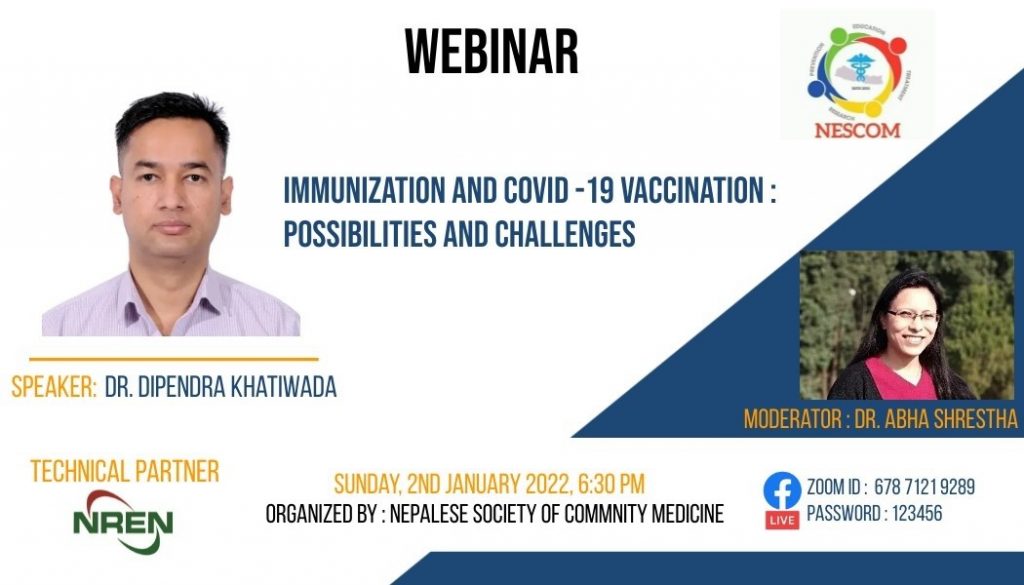
The proceedings of the webinar was started by Master of Ceremony, Dr. Nikita Bhattarai. Dr. Bhattarai started with the introduction of the speaker Dr Dipendra Khatiwada and the moderator Dr. Abha Shrestha. Dr Khatiwada is a Surveillance Medical officer (SMO) and is supporting the immunization unit in WHO-IPD Central Office. He is also supporting the National immunization program including the current COVID-19 vaccination campaign. Dr Abha Shrestha is a lecturer in Kathmandu University School of Medical Sciences (KUSMS) and a coordinator at Nepal NCDI poverty commission; she is currently involved in the home-based isolation care of COVID-19 patients and the vaccination program.
The webinar started with a brief overview of COVID-19 including the present scenario of COVID-19, number of cases, vaccination status and trends globally and nationally. The current situation of the neighboring country (India) and its vaccination coverage status was also discussed as it has direct implications in Nepal due to its open border. Dr. Khatiwada discussed different vaccines given by the Government of Nepal as part of the immunization program. However, his presentation was mostly focusing on COVID-19 vaccines and the COVID-19 vaccine under development around the world and its significance. He briefed about the hurdles faced on the coverage, hesitancy of vaccination in Nepal. The completion of the presentation was followed by many interesting questions raised by the participants making it an immensely interactive session. A 5 question zoom poll was put forward in discussions. The webinar lasted for nearly about 2 hours with 47 participants and ended with the announcement of an upcoming webinar on “Establishing and conducting clinical trials in Nepal.”
Objectives of Webinar:
- To understand the importance of immunization for disease prevention and control.
- To know the status of COVID-19 vaccination globally and nationally.
- To know the hurdles and gaps prevailing in the delivery of COVID-19 vaccinations in terms of coverage, equity and accessibility.
Key points that came out during the discussion:
1. Evidences have shown that immunization alone prevents 2-3 million deaths annually as vaccinations have been developed for more than 20 different diseases
2. It is a best investment for the future producing a healthy return i.e. 1$ spent on immunization gives back $16 in return
3. Immunization has been addressed by the Constitution of Nepal as well as Immunization Act 2072 as an individual human right of every Nepali citizen
4. Nepal started its Expanded Programme on Immunization (EPI) starting initially with BCG and slowly expanded to DPT and scaled up nationally. Subsequently, it added more vaccines to the schedule such as OPV and pentavalent vaccine. Several other vaccines including Typhoid Conjugate Vaccine (TCV) and Human Papilloma Virus (HPV) vaccine are planned for introduction in Nepal in near future
5. Normally vaccines are authorized for use among general population only after they have passed through 4 phases of clinical trials. Any vaccine before its use undergoes series of rigorous scientific experiments and tests, taking 5-6 years duration on an average. While, due to the COVID-19 Pandemic, COVID-19 vaccines have been developed quite quickly in just around 1 year duration of testing and trials to fulfill the demand of time and need. It is the matter of great pride that scientist around the world have spent day and night to make this happen.
6. The COVID vaccines have been authorized only as Emergency Use Listing (EUL) and not as a routine schedule and 9 countries in the world have been authorized for vaccine development so far.
7. The urgent need of protection of the people in the country, its safety and demand led to the prioritization of the vaccine receiving groups. The first prioritized group was the frontline health care workers; it was not only to protect the HCWs but also to encourage people in the country to get vaccinated and to assure safety. Therefore, the second prioritized groups were the elderly population and those with co-morbidity and priority three groups were the general population.
8. There was lots of buzz for booster doses for COVID -19 in many countries and Nepal was also planning for the same for people who have completed two regular doses of vaccines as recommended by WHO-SAGE (Strategic Advisory Group of Experts). However, a full-fledged recommendation from the government is yet to come.
9. Currently discussion is going on regarding homologous vs. heterologous immunization, its benefits and efficacy. However, WHO recommends immunizing with homologous vaccines as far as possible and switching to heterologous series only in case of unavailability of vaccines but the choice again depends solely on individual country contexts and standards.
10. There were discussions regarding the age group to be vaccinated and pediatric vaccination policies. Currently the approved age group for vaccination is above 18 years of age. However, there is gradual addition of younger age groups as many countries have started trials among those below 18 years of age. So far, Pfizer has been listed safe for the 12-17 years of age and other vaccines are on the pipeline.
11. Sinopharm vaccine is under trial with an objective of vaccinating >3 yrs aged children. Similarly, in Cuba and Venezuela, vaccines are under trial for vaccinating >2 years aged children.
12. The reasons for differences in vaccine coverage includes the lack of adequate availability of vaccines and trained manpower, budgetary issues, inability to expand vaccination session sites, hesitancy among general population, preference between different vaccines among people, misinformation regarding vaccines in social media, difficult geographical terrain creating difficulties in accessibility to certain areas, pitfalls in recording and reporting aspects and lack of proper orientation and training to the staffs for data entry.
Point for the policy brief:
To enhance the COVID-19 vaccination a joint collaboration between various countries and stakeholders as well as national and international agencies is paramount. This action needs to be backed with strong health infrastructure, the availability of adequate vaccine stocks in order to reach every single individual. Additionally, trained manpower and information systems need to be strengthened for the efficient delivery of the vaccine.
Points to be discussed in the executive committee:
Role of Nepalese Society of Community Medicine (NESCOM) in involving and utilizing the knowledge and skills of MD students and young graduates in the various aspects of immunization. It could be in the area of technical expertise, policy making, service delivery, monitoring and evaluation and research purposes.
Conclusion:
Immunization is a cost-effective tool to curb the COVID-19 pandemic. To make it a reality, the program needs to emphasize on universal coverage, equity and to increase accessibility to vaccines. The focus should be to clear misconceptions of the general public to reduce vaccine hesitancy. The health sector should be strengthened and health workers should be effectively trained for delivery as well as for strengthening the information system.