
Summary:
There is no disagreement that NCDs are in rising trends in Nepal. However, it cannot be epidemiologically declared that it is an epidemic in Nepal. Various reports, action plan are produced nationally and internationally for the prevention of NCD’s. However strong political commitment, advocacy and evidence generation is needed to counter the aftermath of NCD in Nepal. Multidisciplinary collaboration is the need of an hour. Effective implementation and scaling of PEN and PEN Plus program in all the 7 provinces of the country is a key to reduce the burden of NCD in Nepal.
Brief Background:
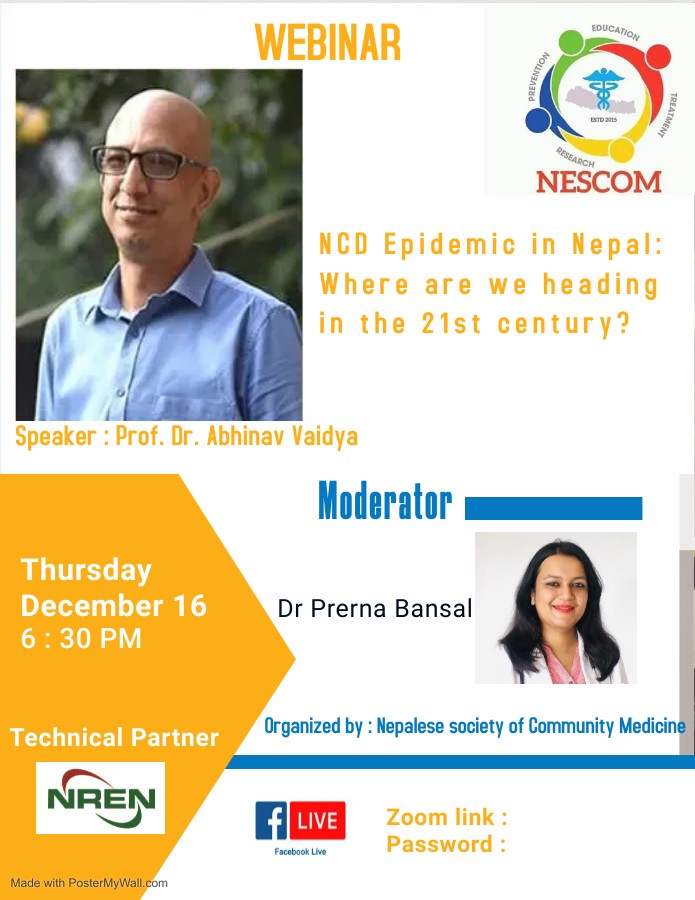
The proceedings of the webinar was started by Master of Ceremony, Dr. Nikita Bhattarai where she read out the bio of the speaker Prof. Dr. Abhinav Vaidya and the moderator Dr. Prerna Bansal. Prof. Vaidya currently works at Kathmandu Medical College and is the faculty in the Department of Community Medicine since 2006. He holds various positions in different national and international bodies and has contributed significantly to NCD Prevention in Nepal. Dr. Bansal who was the moderator of the program currently works at the College of Medical Sciences (COMS) in Chitwan District in Central Nepal. She played an instrumental role working as a focal person during the COVID-19 Pandemic in Chitwan and supported the Government of Nepal in coordinating various activities for COVID-19 Prevention.
The presentation started with the justification of topics (NCD Epidemic in Nepal: Where are we heading in the 21st Century?) by Prof. Vaidya where he emphasized that it is difficult to say epidemiologically that NCD is really an epidemic in Nepal. He gave a brief overview of the prevalence of major NCDs in Nepal and also discussed various documents related to NCD developed in Nepal (Lancet Commission Reports, STEPS Survey, etc.) He briefed about the different policies documents released by the Government of Nepal since 1991 and also the action plans for NCDs nationally and internationally. NCD services continuum of care and best buys for NCDs were also highlighted by Prof. Vaidya. Additionally, he talked about the various documented community intervention in Nepal which includes the HARDIC trial, COBIN trial, the BISHES study, Dhulikhel heart study and the Cohesion Study. He further added on various health intervention programs such as PEN, PEN plus program, Mutu program. He talked on issues of health financing, universal health coverage and sustainable development goals in NCDs. He reiterated that NCDs advocacy in Nepal is sporadic and non-inclusive. He also mentioned on the importance of research in NCDs and talked about increasing the quality of papers. He concluded with remarks on adequate opportunities for NCD to the young community medicine graduates in Nepal.
The completion of the presentation was followed by ice-breaking zoom polls focusing on understanding about Nepalese Society of Community Medicine (NESCOM). Some interesting questions were raised after the poll questions which the speaker answered with very much clarity and precision. The webinar lasted for 2 hours with 61 participants. The webinar ends with the concluding words by Dr. Nikita (MC for the program) with the announcement of an upcoming webinar on “Immunization and COVID-19 Vaccination: Possibilities and Challenges on 2nd January 2022.”
Objectives of Webinar:
- To understand about the situations of NCD in Nepal.
- To understand about the direction of NCD prevention in Nepal.
Key points that came out during the discussion:
- Non communicable diseases (NCD’s) is a rising problem in developing countries like Nepal. Quality research should be produced to design interventions relevant to the context.
- Factors responsible for the increase in NCD’s are tobacco use, unhealthy diets, low physical activity, use of alcohol with air pollution being a new addition.
- The Nepal NCDI Poverty Commission reports shared a data about burden of disease from NCD’s and injuries (1990-2015), which showed that NCD’s cases and injuries seems to be going up where as the communicable diseases has shrunk.
- According to the recent data in Nepal the mortality due to NCD is rising having prevalence of more than 70%. However, the funding is very low compared to the burden of the disease.
- NCDs has been in rising trend in Nepal and the recent policy is to strengthen national capacity, leadership, governance and research. However, the quality of research needs more refinement.
- The global action plan 2013, was the basis on which the South East Asian goals and targets came up. It was a historic moment when Nepal first came up to address its NCD’s issues.
- In multi-sectorial NCD action plan (2014-2019), there was an inclusion of 3 diseases (Oral health, Mental health, Road Traffic injuries) and addition of one risk factor (indoor air pollution).
- In the reflections and learnings from Multi-sectoral NCD Action plan 2014-2020 there is the need of commitment from the top political level. Hence, the upcoming action plan should add on establishment of NCD division at MOHP, mainstreaming of NCD related programs in the line ministries, adequacy of trained man power in the provincial and local level.
- Tobacco, alcohol, unhealthy diets and physical activity are still some of the major risk factors for NCDs which needs to be addressed in Nepal.
- NCD Services: PEN package is a key programme for the NCD prevention in the country at the moment. It has 4 protocols and has been gradually scaled up across different parts of the country. Protocol 1 addressed on HTN, DM, prevention of heart attacks, stroke and kidney disease. Protocol 2 talks on health education and counselling on healthy behavior, Protocol 3 is on COPD diagnosis and treatment and Protocol 4 is on the assessment of breast and cervical cancer and its appropriate referral.
- PEN plus program is an integrated strategy that builds on existing PEN program to increase the quality of services and decentralization for severe NCDs at primary referral facilities.
- The relationship between economy and NCD’s is a complicated one as the cases of NCD is rising which has proportionate effect on the economy, health system, households, families. This in turn has financial pressure in all sectors. The poor are more affected by NCD’s like IHD, asthma, COPD, Hemorrhagic stroke, Rheumatic heart disease.
- In Nepal, one third (36%) of health expenditure is due to NCD’s. Hence UHC should be achieved by including additional services, reducing cost sharing and fees and out of pocket expenditure.
- 4% of total government health expenditure is for NCD’s in Nepal.
- NCD’s research in Nepal has taken up. Within the last five years various form of research work such as secondary data analysis, systematic review and meta-analysis, system research, policy analysis, implementation research and digital intervention has been done.
- Advocacy efforts need to be streamlined and amplified. Multidisciplinary health care workers along the different government bodies need to be aligned in one pathway to reduce the burden of NCD in Nepal.
Point for the policy brief:
To push back NCDs, Nepal needs adequate manpower trained in NCD prevention at various levels (NCD Champions). The government of Nepal should involve Community Medicine graduates in various capacities to generate evidence for NCD prevention and scaling up the PEN and PEN Plus programs.
Points to be discussed in the executive committee:
- Role of Nepalese Society of Community Medicine (NESCOM) for capacity building of Community Medicine residents and graduates for the prevention of NCDs in Nepal.
- Building partnership with the Government of Nepal in implementing PEN and PEN Plus Program in all the 7 provinces of the country.
Conclusion:
NCD’s are in a rising trend in Nepal. If not controlled it will have a huge burden on the health system in the upcoming days. Various context-specific health promotion and preventive strategies need to be developed. A high level of political commitment and strong advocacy is needed for its prevention.