
Summary:
Brief Background:
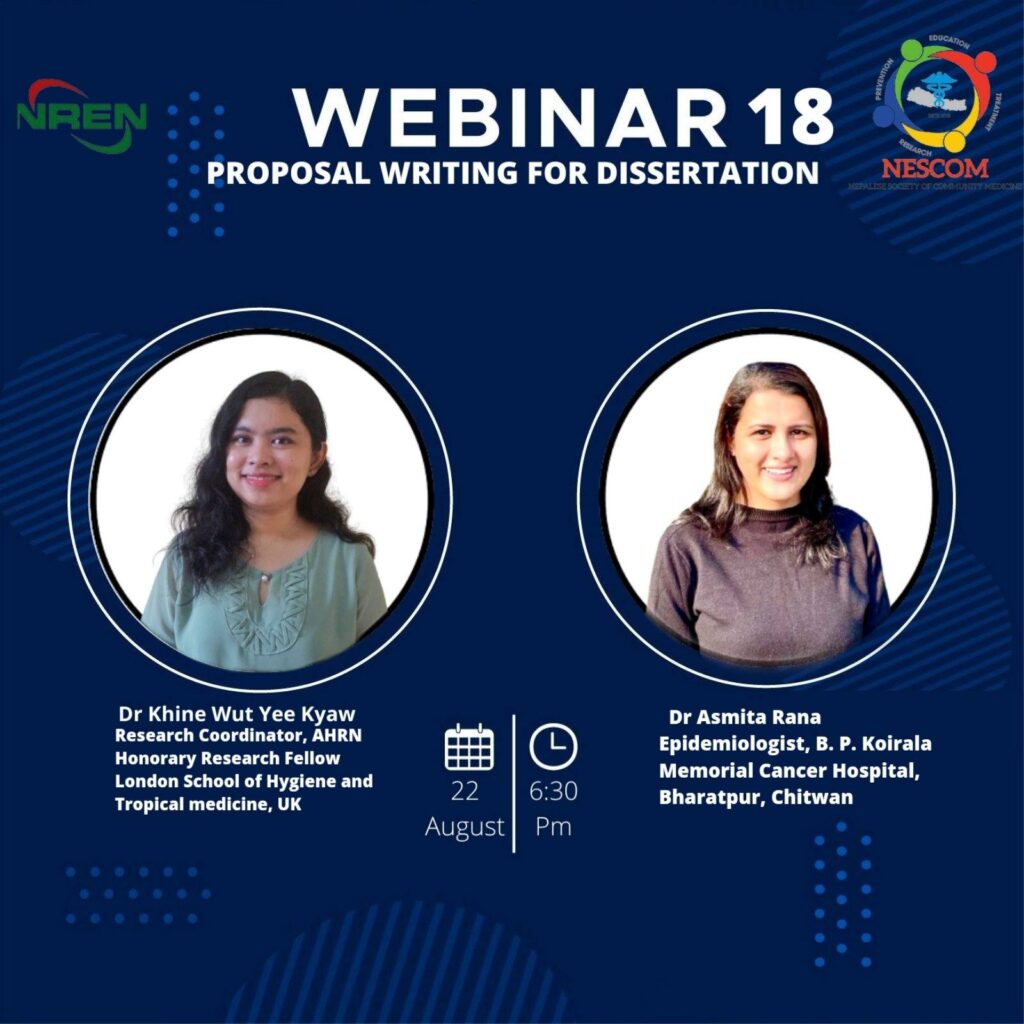
The webinar started off with the Master of the ceremony, Dr. Sujata Poudel introducing us to the speaker of the webinar Dr. Khine Wut Yee Kyaw, and the moderator Dr. Asmita Rana. Dr. Khine Wut Yee Kyaw is a research coordinator at AHRN (Asian Harm Reduction Network), Myanmar. She is an Honorary research fellow, at the London School of Hygiene and Tropical Medicine, U.K. She is a Public Health Professional and has been working in the field for 10 years. She has experience in operational research for about 5 years and has published thirty articles in peer- reviews international journals. She also has mentored junior researchers from Myanmar and many Asian countries through WHO-TDR-endorsed Structured Operational Research Training Initiative (SORT IT) courses and many more.
Dr. Asmita Rana, the program moderator, is a graduate of MD Community Medicine from the College of Medical Science. She is currently working as an Epidemiologist in B.P Koirala Memorial Cancer Hospital, Bharatpur, Chitwan in the department of cancer prevention, control, and research. She has organized various community-based programs such as Community-based cervical cancer, breast cancer, and oral cancer screening programs, School-based cancer awareness program, and the Planning Human Papillomavirus vaccination pilot project. She is a principal Investigator in the “Delays in Diagnosis and treatment of adult and childhood cancers in Nepal (DECAN projects) IARC/BPKMCH collaboration project.
The Presentation ended with a keynote “Question well asked is a question half answered” the most important part of the proposal writing is to frame a good research question by using FINER technique (Feasible, Interesting, Novel, Ethical, Relevant) if we develop a good research question then we can generate our Aims /objectives and can outline the background accordingly. Depending upon the research question methodology of the study varies. Safeguarding the dignity, rights, safety, and well-being of the research participants should be taken into consideration. The implication of the study will determine whether it will impact the current guidelines, public health prevention, policy, knowledge gap, and theory that can make a potential impact on the country’s health system.
The webinar ended with acknowledgment from the Master of Ceremony. The General Secretary of NESCOM, Dr. Prajjwal Pyakurel presented the speaker Dr. Khine Wut Yee Kyaw with an E –Certificate as a vote of thanks and appreciation from the participants. The webinar lasted about an hour with about eighty participants and ended with an announcement of the next webinar on “Community Based Intervention for Diabetes Prevention in Bharatpur, Chitwan”.
Objectives of the webinar:
- To know the process of research proposal writing for thesis and other research purposes
- To list the steps of the proposal writing
Key Points Discussed during the webinar:
- A proposal is a detailed plan or blueprint for the intended research. A proposal is considered the most rigorous aspect of the research /thesis. There is no single universal format for proposal writing in research. Different institutions and organizations have different formats and conditions for proposals.
The Structure of a Research Proposal according to Dr. Khine Wut Yee Kyaw consists of the following steps: –
- Title
- Background
- Aims and objectives
- Method
- Ethical Consideration
- Implications and funding
- The first step in any research is to identify a research problem, to come up with different ideas, translate those ideas into research and describe what aspects of that you will emphasize. Before selecting a research topic, a few things must be kept in mind, the research should be in the interest of the researcher, feasible to the work, should have resources at hand and meet the ethical concerns
- Once the problem is identified, the next step is to collect as much information that is suitable for the research/thesis. Extensive literature review is a fundamental part of the research processes. The main objective of the literature review is to know the existing research and controversies that are relevant to the study
- Research question is formulated after the research problem is identified. The research question is formulated on basis of FINER criteria
- Feasible: Adequate number of study participants, technical experience, affordable time and cost and has a testable hypothesis
- Interesting to the investigator: Interesting to the investigator, your peers/ other researchers, journal editors/ reviewers, possible funders, policymakers
- Novel: Essential pre-requisite for publishing ability. Improving the methodology of previous studies to address previous limitations and obtain more valid findings
- Ethical: A good Research Question must be ethical; it must be able to approve by your institutional review board.
- Relevant: Will the study influence practice guideline? Influence health policy? advance scientific knowledge? Guide future research? The research question also must have a frame. How to frame a research question according to PICOT criteria?
- Populations: Who is the population and what problem is being addressed?
- Interventions (or exposures): What is the intervention or exposure?
- Comparison: What is the comparison group (if applicable)?
- Outcomes: What is the outcome or endpoint?
- Time frame: Duration of intervention or a reasonable follow-up time period in which outcome is expected to occur
- The research question helps create a research hypothesis. The means in which the question (or hypothesis) is asserted shows what data will be required to answer (or test) it. It also proposes how and from where or from whom the data will be obtained.
6. Aim: Broad statement of desired outcomes or the general intentions of the research
- Objective: A clear, concise and specific statement that needs to be accomplished over time period. It focuses on what we are trying to achieve. The Characteristics of objectives should consist of the following mnemonic SMART.
- Specific: Describe the outcome in a way that is detailed, focused, and well defined
- Measurable: Tangible evidence that you have completed the goal
- Achievable: Attainable or feasible within a reasonable time frame
- Realistic: Achievable within available resource
- Time Bound: Should be accomplished within a time frame
- Methodology is the most important step of proposal writing and should describe methods utilized to complete the research. It should take into consideration the following
- Setting – relevant general and specific settings
- Study design
- Population and sample
- Sample size – if applicable
- Data collection
- Data analysis
- Methodology – Study design. It can be quantitative study design, qualitative study design or mixed-methods study design. Quantitative study is experimental or observational (descriptive or analytic) cross-sectional, case-control or cohort. In qualitative the researchers in this study design gather and collect what they see, hear, and read from people and places, from events and activities, with the purpose to learn about the community and generating in-depth understanding. The art of asking “Why?” and “Listening”
8. The population and sample the following definition of the subject of study and the target population should be clearly spelled out.
- Target/Reference population : Complete set of people with characteristics of interest. Population to which the investigator hopes to generalize the findings
- Accessible population: Geographically /temporally available subset of the target population. Practical representation of the reference population.
Study Population or Sample Subset of the accessible population enrolled in the study.
9. Sampling Methods and Sample Size Sampling: The act of drawing a sample from a population so that the sample is representative of the population
10. Data collection: Once the protocol is finalized, the data should be collected. The data collection will depend on the design of the study.
11. Data analysis: The data analysis is based on objectives, dummy tables/ figures, and leans on previous studies. What to write during data analysis?
- First: Descriptive table (mean, median, frequency, proportion, p-value).
- Second: Analytical table (inferential statistic) 95% Confidence Interval, regression analysis (Odd’s Ratio, Relative Risk, Hazard Ratio). Figure – flow diagram – mostly used in a cohort study
- Ethical Consideration: Must be scientifically justified. An Independent review individual unaffiliated with the research. Respect for persons Opportunity to choose what will/will not happen to them information, comprehension, and voluntariness
- Implications and funding: The possible positive/negative, primary/secondary impacts the study will make on the program, public health intervention, clinical practice, policy, future research, knowledge gap, and theory. Hence, the things you need to consider when you prepare the proposal are
- Justification
- Is there a clearly stated research question and objectives?
- What data is required to answer the research questions?
- Who are the study participants?
- Who will collect the data and how will it be collected?
- What are the study procedures? How safe are they?
- What will be done with the data?
Points for the policy brief:
- Proposal written will be for study on the program, public health interventions, clinical practice, policy, future research, knowledge gap, and theory that can make a potential impact on the country’s health system
- Proposal can serve as a vehicle for evidence-based policy to help the concerned stakeholders make decisions and develop appropriate policy initiatives
Hence it is imperative that concerned stakeholders in government sector design appropriate framework to inculcate proposal writing workshop and training regularly in the health system for the academician/researcher of the country
Points to be discussed in the executive committee:
The following points should be considered in the forthcoming Executive Committee:
- The capacity building of the residents for creating proposals
for a thesis or any other research.
- The regular training regarding the various types of research through webinars
Conclusion:
A research proposal is the basis for the Master’s thesis program and is also necessary for other academic paper writing. Proposal writing is an essential step for conducting research or starting thesis work. The process of proposal writing starts with the intent and outline of a statement of the idea of the study that the researcher works on. The proposal shows the value of the program/project one is working on. Hence it is a necessary step to learn from scholars to write a proposal for a thesis, research, or a project.