
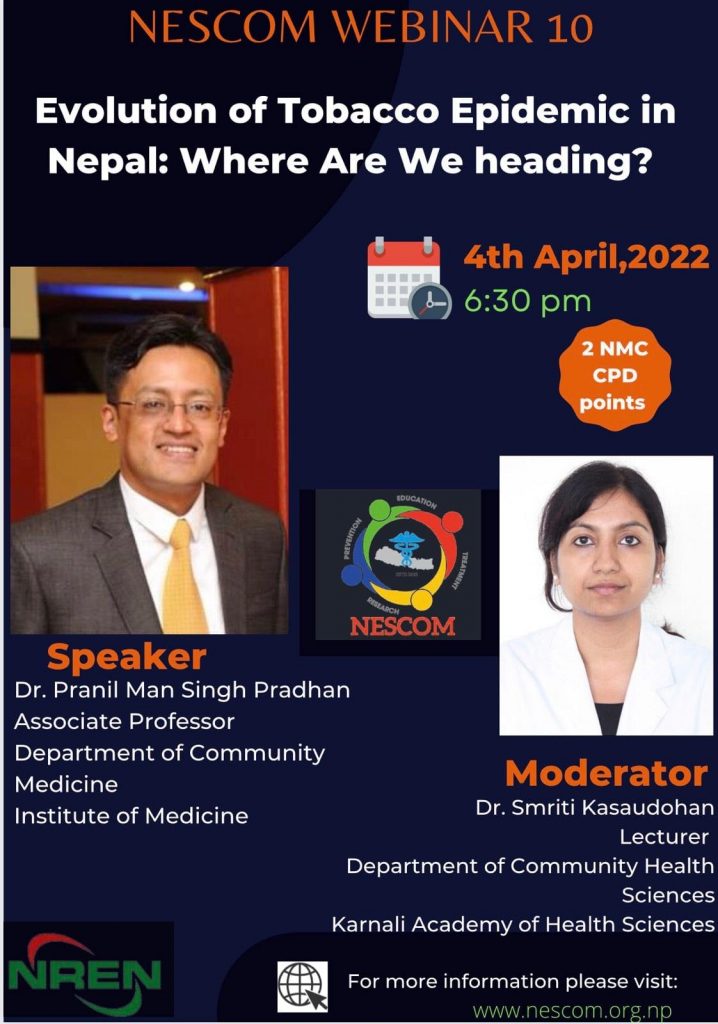
Summary:
Tobacco epidemics is one of the biggest public health problems worldwide with Nepal being no exception. Various factors like higher age, low education, poverty, occupation (agriculture and unskilled work) have shown higher rate of tobacco use. Nepal having signed WHO Framework Convention on Tobacco Control (FCTC) in 2003 and implementing various Tobacco Control Acts and Strategy still have work cut out in controlling tobacco epidemics. The reason being the tobacco industry influence on tobacco control by taking advantage of unstable governments and corruption. Studies have shown that there has been decline in the prevalence of tobacco smoking in recent years. However, the use of smokeless tobacco products is in increasing trend in youth population. Hence, policies need to be developed in such a way that it is adolescent friendly. Nepal has achieved 3 measures of MPOWER strategy which includes 1. Protect people from tobacco smoke 2. Warn about the dangers of tobacco 3. Enforce bans on tobacco advertising, promotion and sponsorship. Proper monitoring of tobacco uses and implementation of prevention policies is need of an hour. Additionally, tobacco quit line and trained human resource to facilitate tobacco quitting needs massive revamp. Increasing taxation is highly cost-effective measure to decrease tobacco use. However, the big powerhouse industries need to be tackled well to develop those tobacco control policies. WHO report on Global tobacco epidemic 2021 have highlighted on the new and emerging tobacco products as a new challenge due to its misconception of being harmless and not contacting tobacco.
The session started with the quote by David Kessler that says “If public health is to be the center piece of tobacco control our goal is to halt this manmade epidemic – the tobacco industry, as currently configured, needs to be dismantled”. Dr. Pradhan gave a brief overview of trend of tobacco use over the years globally and in Nepal. He discussed on determinants of tobacco use with the results of various published studies. He then pointed out different legislations before and after Nepal signed WHO FCTC and implementation gaps including MPOWER strategies. He also focused on the challenges and scope of tobacco control. The completion of the presentation was followed by many interesting questions raised by the participants, making it an immensely interactive session. A zoom poll with 5 questions was also put forward after the end of discussions. The webinar lasted for nearly two hours. Dr. Pradhan was presented with the certificate of appreciation on behalf of NESCOM. At the end of the webinar the topic of the upcoming webinar was announced “Artificial Intelligence boon or destruction in Futuristic Diagnostic Medicine and Public Health: Where are we heading?”
Objectives of the webinar:
- To understand the trend and burden of tobacco epidemics in Nepal
- To understand the determinants of Tobacco smoking in Nepal
- To understand the policy-implementation gaps in tobacco use among Nepalese population
- To know various new and emerging smoke free tobacco products
- To understand the challenges and future scope of tobacco control in Nepal
Key points discussed:
- Trend of tobacco use worldwide and in Nepal
- There has been reduction in use of tobacco, however use of smokeless tobacco among youth population has increased
- Studies have shown that higher age, low education, poverty, occupation (agriculture, unskilled workers), urban areas, Terai residents have higher rate of tobacco use
- In 1992, executive order restricting smoking in public places and taxation on tobacco products was placed in Nepal
- In 1993 taxation on tobacco products was implemented with the establishment of NHEICC (National Health, Education, Information and Communication Centre)
- In 2003 Nepal signed WHO FCTC convention which was ratified in 2006. Tobacco Product (Control and Regulatory) Act was implemented in 2010
- Article 11 of Tobacco Product (Control and Regulatory) Act states that “No person shall be allowed to sell and distribute or provide the tobacco products for free to a person below 18 and to the pregnant woman. In case the seller wants to be sure about the buyer to sell tobacco products, the seller may ask for necessary proof to verify the age and shall be the obligation of the buyer to provide such evidence.” It also states that “no person shall be allowed to sell tobacco products within the span of 100-meter distance from educational and health institutions, child welfare homes, child care centers, elders’ care home and other public places prescribed by Government of Nepal”
- MPOWER strategy is based on provision of WHO FCTC to reduce the overall Tobacco demand. Nepal has achieved three out of six measures of MPOWER strategy, whereas the other three strategies which needs to be achieved are to Monitor tobacco use and prevention policies, Offer help to quit tobacco use and Raise taxes. Political instability or conflict, corruption, and influence of tobacco industries in tobacco control policy have significant negative effects on tobacco control
- Studies have shown that there has not been proper implementation of some Tobacco control and Regulatory acts. According to a qualitative study published in Journal of NHRC on compliance of tobacco control law implementation, against the law there has been sale of tobacco products to children and establishment of tobacco vendors very close to school areas
- Government of Nepal has not been able to establish national level of quit line strategies. Chances of quitting is two times more with professional support and cessation services
- NDRI (Nepal Development Research Institute) report have shown that Nepal has one of the lowest taxation rates in South East Asia Region (30%). Also, the amount of health hazard taxes generated goes under curative but not on preventive aspect
- In 2015 Nepal was presented with the Bloomberg Award for Global Tobacco Control in recognition of its new law on graphic health warnings for tobacco packaging. Covering 90 percent of the surface area of tobacco packs, it has the largest warning labels in the world. However, the VAT stickers over warning signs, unclear pictures on the packets has reduced the compliance of the warning
- Interventions for people wanting to quit tobacco are toll free quit lines- reactive and practice, text message support, chatbots (WHO Quit Program and WhatsApp and Viber), mobile apps, artificial intelligence, digital health worker and pharmacotherapy for nicotine dependence
- WHO report on the Global Tobacco Epidemic, 2021 addressing new and emerging tobacco products are aggressively marketed as ´safer´ and ´smoke free´. But they are still addictive and not without harm. One of the main risks of these new products is that, once the people take these products it will increase the risk of that person taking up smoking habit in the future
- E-cigarette has no direct tobacco but has nicotine derived from tobacco added in E-liquid, it is vaporized with charge and don’t generate any smoke. Heated Tobacco product heats tobacco unlike conventional cigarette smoking which burns tobacco
Points for the policy brief:
- Increasing taxes is a highly cost-effective measure to decrease tobacco use (10% tax increase leads to 4% decrease in consumption)
- Adolescent centered policies to protect the youth from taking up tobacco products
- Proper surveillance of Tobacco control and regulatory acts and reduce the policy – implementation gaps
- Government has yet to address on the rampant sales and advertisement of online tobacco products
Points to be discussed in executive committee:
- Role of Nepalese Society of Community Medicine (NESCOM) and Community Medicine graduates in control of Tobacco epidemics
- Mechanism of coordination, collaboration with public, private and international agencies
Conclusions:
Tobacco epidemics is a very essential topic that needs to be addressed. Although there is Tobacco Control and Regulatory act in papers, proper surveillance and monitoring of its implementation is still lacking in Nepal. Higher prevalence of tobacco consumption among the illiterate, poor, older people and those with agricultural and unskilled workers illuminates the target groups that need to be targeted while designing and implementing tobacco control interventions. Proper advocacy among stakeholders, increasing taxation, adolescent centered polices and researches on effective intervention are must for controlling Tobacco epidemics in Nepal